Blog
What a robocall is, and which are legal
A robocall is any call that plays a recording. Some are legal, some need your written permission, and most of the volume is neither. Where the line sits.
John · Owner and CEO · 5 min read ·
A robocall is a call that plays a recording instead of putting a person on the line. That is the whole of the definition. Your dentist's appointment reminder is a robocall. So is the recorded pitch about a car warranty you never bought. What separates them is consent and purpose, not the technology that placed them.
This is the overview for the rest of this cluster. Each section has a longer article behind it.
The word describes a method, not a verdict
People use "robocall" to mean "a call I did not want", and that is the source of most of the confusion about what anyone can do about them.
Automated dialling is ordinary infrastructure. Pharmacies use it to say a prescription is ready. Airlines use it when a flight moves. Schools use it for a snow day. None of that is a grey area, and none of it is what anybody is complaining about.
The complaint is about recorded sales calls, and about outright fraud dressed up as a recorded sales call. Both are placed with the same equipment as the pharmacy uses, which is exactly why "ban robocalls" has never been the answer anyone can actually implement.
Where the legal line sits
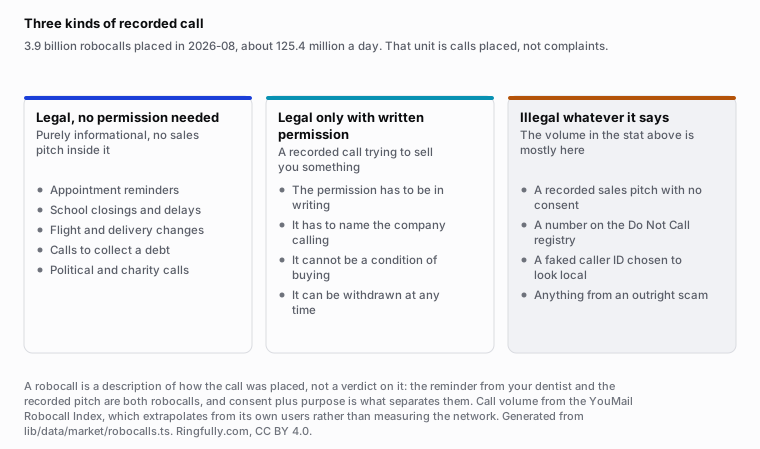
Robocall describes how a call was placed, not whether it was allowed. Consent and purpose decide the rest.
Reuse this figure anywhere, including commercially, with credit to Ringfully and a link back to this page. CC BY 4.0.
The Federal Trade Commission puts it plainly on its consumer page about robocalls: "A robocall trying to sell you something is illegal unless the company trying to sell you something got written permission, directly from you, to call you that way." The same page notes that messages which are purely informational, and calls to collect a debt, are not illegal.
So there are three categories, not two.
Legal without asking you. Informational recorded calls with no sales pitch inside them. Reminders, closings, delays, delivery windows. Political calls and charity calls sit here too.
Legal only with written permission. A recorded call whose purpose is to sell. The permission has to be in writing, has to name the company doing the calling, cannot be a condition of buying something, and can be withdrawn.
Illegal whatever the recording says. A recorded sales pitch placed without that permission. Everything from an outright scam. Anything that fakes its caller ID to look like a neighbour, which the FTC's advice on phone scams describes bluntly: "Scammers can make any name or number show up on your caller ID."
The middle category is where every argument about the law actually happens. The third category is where nearly all of the volume is.
The scale of it
The YouMail Robocall Index estimated 3.9 billion robocalls placed in the United States in August 2026: about 125.4 million a day, or roughly 11.8 per person over the month. Those figures are published monthly at robocallindex.com, and they are extrapolated from YouMail's own user base rather than measured across the network, which is worth carrying with the number.
Set that beside the complaint count and the mismatch is instructive. The FTC recorded 2.6 million Do Not Call complaints in fiscal year 2025, down from 5 million in fiscal 2021, in its National Do Not Call Registry Data Book.
Those two numbers count different things and must not be added or compared directly. One is calls placed. The other is people who took the trouble to report something. A falling complaint count is not evidence that calls fell. It is at least as good evidence that people gave up reporting.
Why blocking the number never catches up
The number a spam campaign shows is not its identity. It is a wrapper, rented, spent and replaced.
The cycle runs: dial from a fresh number, get answered at whatever rate a local-looking caller ID buys you, accumulate short calls and rejections, get labelled by carrier analytics, watch the answer rate collapse, drop the number, take the next one. Blocking the number happens at the point where the campaign was about to discard it anyway.
That mechanism is the subject of why you get so many spam calls, and it is the reason a personal block list feels like bailing out a boat.
The name beside the number is a separate mechanism from the call itself, set out in how caller ID actually works, and the same asymmetry is why your own business name can show up wrong on a stranger's screen. If you want to check what a particular number resolves to, what a caller ID lookup can tell you is honest about the limits of those services.
If you are the one placing calls
There is a second half to this topic that has nothing to do with being annoyed at dinner.
If your business calls people who have not asked to hear from you, you are subject to a set of rules with real teeth: a national registry you have to scrub against on a schedule, windows during which an existing customer may still be called, an internal do-not-call list you have to keep forever, and records that have to survive an inspection. What the do-not-call rules ask of you covers the obligations, and how to scrub a calling list covers the process in order.
Nothing here is legal advice. It is a map of which published rules apply to which activity, and the regulators publish all of it themselves.
What a small business can actually do about the ones it receives
Two things, in this order.
Decide what happens before a person is involved. A short greeting that asks the caller to press a key removes essentially all automated traffic, because a dialler does not press keys. It also turns away a share of real customers, and that trade is the whole subject of screening calls without losing customers.
Stop treating every unrecognised number as a threat. For most service businesses, the calls that cost real money are the ones that never got answered, not the ones that should not have been placed. What missed calls are actually worth does that arithmetic, and it usually dwarfs the nuisance.
The practical measures, ordered by how much each one removes, are in how to block unwanted calls.
Where to go next
- Why you get so many spam calls for the mechanism behind the volume.
- How to block unwanted calls for what to do, ordered by effect.
- Screening calls without losing customers for the business-side trade.
- The Do Not Call list, explained for what registering does and does not do.
- Everything else in spam and call blocking.
If you want a second opinion on what your own number is doing to callers before anyone picks up, get in touch and we will walk through it with you.
Questions people ask
- What is a robocall?
- A call that plays a recording instead of connecting you to a person. The word describes how the call was made, not whether it was allowed. An appointment reminder from a clinic and a recorded pitch about a car warranty are both robocalls.
- Are all robocalls illegal?
- No. Purely informational recorded calls are legal without your permission: appointment reminders, school closings, delivery changes, calls to collect a debt, political calls and charity calls. A recorded call trying to sell you something is illegal unless the seller has your written permission to call you that way.
- How many robocalls are there?
- The YouMail Robocall Index estimated 3.9 billion robocalls placed in the United States in August 2026, about 125.4 million a day, or roughly 11.8 per person for the month. That is an estimate extrapolated from YouMail's own users rather than a measurement of the whole network.
- Why does blocking the number never work?
- Because the number is the cheapest part of the operation. A campaign runs a number until carrier scoring labels it, then drops it and dials from the next one in the pool. Blocking removes one number from a pool that refills the same day.
- Does the Do Not Call registry stop robocalls?
- It stops sales calls from companies that intend to follow the rules, and it does that reasonably well. It has no effect on anyone already breaking the law, and it never covered charities, political calls, surveys, debt collectors or a company you recently bought from.
- Can my business be blamed for calls it did not make?
- Your number can be labelled without you doing anything wrong. Carrier analytics score behaviour, so a short burst of unanswered outbound calls from a new number can look like a campaign. It is worth calling your own number from an outside line every few months to see what it says.
About the author
John
Owner and CEO
Owner and CEO with over 10 years of experience in the IT industry, including more than 5 years specializing in VoIP and cloud communications. Experienced in designing, deploying, and supporting reliable communication solutions for businesses.

Keep reading
If unwanted calls are burying the ones from customers, or your own number shows up wrong when you call out, tell us which, and we will say what a phone system can change and what it cannot.