Blog
Why your business name shows up wrong
Your caller ID name is a record other carriers may or may not read. Who controls it, why displays disagree, and why no provider can guarantee the result.
John · Owner and CEO · 6 min read ·
Because the name on a caller's screen was never sent by you. It was looked up by the carrier delivering the call, from a database that may hold a record filed by whoever had your number before you, or by your own provider years ago. Your call is correct. The record somebody read is not.
That distinction decides what you can do about it, and how much of it is within reach. It builds on how caller ID actually works, and belongs with the rest of spam and call blocking.
Who actually controls the name
Three parties, and only one of them is on your side of the transaction.
You choose the name and ask for it. That is the whole of your involvement, and it is real: the request has to come from the subscriber to the number.
The provider that serves your number writes the record. They are the only party with authority to file a name for that number, which is why the answer to "who do I ask" is always "whoever gives you dial tone", not whoever built your website or sold you handsets.
Every carrier that receives one of your calls decides, independently and for itself, whether to look a name up at all and which database to ask. This is where control ends. There is no central register, no authority that pushes a correction outward, and nobody with the standing to make a receiving carrier read one database rather than another.
That third party is the reason this article exists, and the reason it has that much freedom is that nothing obliges it to show a name at all. The federal delivery rule, 47 CFR 64.1601(a), requires carriers to pass on the calling party's telephone number. It says nothing about a name anywhere in the section, so displaying one is a service a receiving carrier chooses to buy, not a duty it owes you. Twilio's own caller name lookup documentation prices that reality plainly: the query is "billed per request, even if no data is returned".
Why four phones show four different things
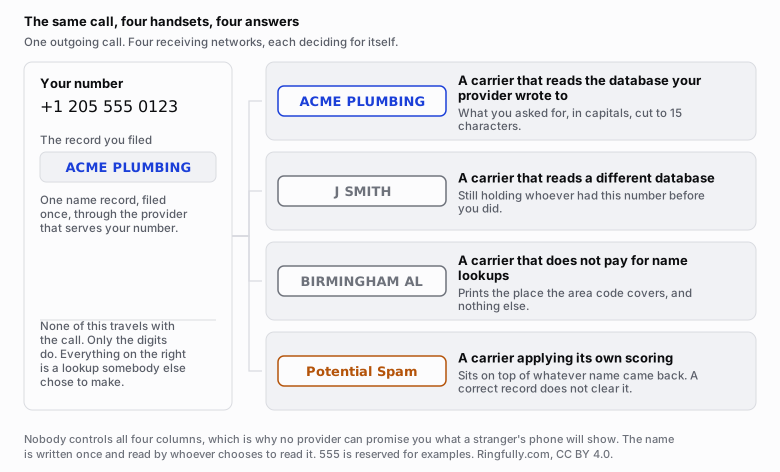
One number, one filed record, four receiving carriers. Each decides separately what to print, and none of the four is malfunctioning.
Reuse this figure anywhere, including commercially, with credit to Ringfully and a link back to this page. CC BY 4.0.
Read the figure as four correct outcomes rather than one right and three wrong.
The first carrier reads the database your provider wrote to, and prints what you asked for, in capitals, cut to fifteen characters. The second reads a different database, one that has not been updated since the number changed hands, and prints the previous subscriber. The third does not pay for name lookups and prints the place the area code covers. The fourth applies its own scoring on top and prints a warning instead.
None of those is a malfunction. Each is a receiving network doing exactly what it decided to do, and the only thing they have in common is that none of them asked you.
What "wrong" usually turns out to be
Four causes account for nearly all of it.
The number changed hands and the old record did not. Numbers are released and reissued. If the previous holder filed a name and nobody replaced it, the record is still sitting there, correct as far as the database knows and years out of date.
Nobody ever filed one. A number provisioned without a name record has nothing to find, so carriers that look show whatever their fallback is, commonly the city and state.
It was filed once and never re-filed after something changed. A rebrand, a merger, a move to a different provider. The record does not follow any of those on its own.
It was truncated on the way in. The field is fifteen characters and the name was longer, so somebody shortened it, and "Northside Family Dentistry" came out as something nobody would recognise.
That last one is worth handling before you file anything, because it is the only cause you can fully control. Twenty-six characters do not fit in fifteen. Decide what the fifteen say, or find out later what somebody else decided.
How long a correction takes
Longer than you want, and unevenly.
The write itself is fast. What takes time is other operators picking it up, on their own refresh cycles, with no coordination between them. So the honest expectation is days to weeks, and a period in the middle where the same call shows the new name on one carrier and the old one on another.
Nobody can give you a firm date, because the date belongs to organisations that did not agree to one. A provider quoting you an exact figure is quoting the part they do, which is the first step of several.
What you can do is measure it rather than wonder. Call two or three outside phones on different carriers, note what each shows, and check again in a fortnight. That is a real answer about your number rather than a general claim about the system.
Spam labels are a different problem
The most useful thing in this article, and the easiest to get wrong.
A caller-name record and a carrier's spam scoring are separate fields decided by separate parties. The label sits on top of whatever name came back. So correcting your name record does not clear a spam label, and no amount of re-filing will, because the two mechanisms never touch.
They look identical on a handset, which is why people spend weeks fixing the wrong thing. The tell is what is displayed: a wrong or missing name is a record problem, and a warning is a scoring problem.
Scoring is driven by how a number behaves. High volumes of short outbound calls to people who do not answer, a number that has just started calling after being quiet, and complaints from people who were called. None of those is fixed at a database. They are fixed by calling fewer strangers and by having a number with a history.
What is actually worth doing
In order, and the first one is free.
- Find out what is being shown now. Call two or three phones on different carriers and write down what each displays. Guessing at the problem is how people file a correction they did not need.
- Decide the fifteen characters. Say the name out loud in its shortened form and check somebody would recognise it.
- File it through the provider that serves the number. Not your website host, not the handset vendor. Whoever gives you dial tone.
- Wait a fortnight, then re-check the same phones. Uneven results are normal at that point and not evidence of a failure.
- If the problem is a warning rather than a name, stop filing and look at calling behaviour instead. Different mechanism, different fix.
And the limit worth accepting: your name is a courtesy, not a channel. It is fifteen capital letters that some phones will show and others will not, and it cannot carry anything a customer actually needs. Everything that matters is in what happens when they pick up, which is why the six phone messages every business needs is a better use of an afternoon than a fifth attempt at a database record.
Ringfully files a name record by hand when a number is set up, because numbers here are provisioned by a person rather than bought from a page, and we will tell you exactly what was filed and where. What we will not tell you is what a stranger's carrier is going to do with it. If your current display is wrong and you want to know what it would take to change, send us the number and what it shows.
Questions people ask
- Why does my caller ID show the wrong business name?
- Almost always because the record being read is not the one you filed. The name is not sent with your call; it is looked up by the carrier receiving it, from a database that may hold a record filed by a previous holder of the number, or by your own provider years ago. The call is fine. The database somebody read is stale.
- Who controls my caller ID name?
- You file it through the provider that serves the number, and they write it to a database. From that point it is out of everybody's hands: each receiving carrier decides for itself whether to look a name up and which database to ask. You control what is filed. Nobody controls what is read.
- How long does a caller ID name change take?
- Expect days to weeks rather than minutes, and expect it to be uneven. A record is written in one place and picked up by other operators on their own schedules, so the same call can show the new name on one carrier and the old one on another for a while. Anyone quoting you a precise time is quoting one step of several.
- Why do different phones show different names for my number?
- Because each receiving carrier makes its own decision. One reads the database your provider wrote to and shows your name. One reads a different database still holding the previous subscriber. One does not pay for lookups at all and shows the area code's city and state. None of the three is broken.
- My number shows as spam, not as the wrong name. Is that the same problem?
- No, and this is the important distinction. A spam label is applied by the receiving network's own scoring, on top of whatever name came back. Correcting the name record does not clear it, because they are different fields decided by different parties. The two problems look alike on a screen and have nothing to do with each other.
- Can a provider guarantee my name will display correctly?
- No, and an honest one will say so. Displaying a name requires a receiving carrier to choose to look one up, in a database your provider does not operate, holding a record it does not maintain. A provider can guarantee what it files. Nothing beyond that is theirs to promise.
About the author
John
Owner and CEO
Owner and CEO with over 10 years of experience in the IT industry, including more than 5 years specializing in VoIP and cloud communications. Experienced in designing, deploying, and supporting reliable communication solutions for businesses.

Keep reading
If unwanted calls are burying the ones from customers, or your own number shows up wrong when you call out, tell us which, and we will say what a phone system can change and what it cannot.