Blog
How caller ID actually works
The number travels with the call. The name does not. One fact about how the two are delivered explains almost every caller ID question a business has.
John · Owner and CEO · 7 min read ·
The number and the name reach your phone by completely different routes. The number travels with the call. The name does not: it is looked up afterwards by the carrier receiving the call, from a database the caller's carrier neither controls nor can see. Almost every confusing thing about caller ID follows from that one split.
Once you know it, questions that seemed arbitrary stop being arbitrary. Here is the mechanism, and what it means for a business whose number is on a van. It is the starting point for the rest of spam and call blocking.
What actually travels with the call
Two things, and it is a short list.
The calling party's telephone number. This one is required. The federal delivery rule, 47 CFR 64.1601(a), obliges carriers and interconnected voice-over-internet providers to "transmit for all PSTN Traffic the telephone number received from or assigned to or otherwise associated with the calling party".
A privacy flag. A marker saying whether the number may be displayed. This is what makes a call show as private or blocked. The number is still there; the receiving side has been told not to show it.
Now read that rule again and notice what is missing. It says nothing about a name. Not a word, anywhere in the section. The asymmetry people find so puzzling is not an implementation accident, it is what the rules ask for: the digits are mandatory freight and the name is not freight at all.
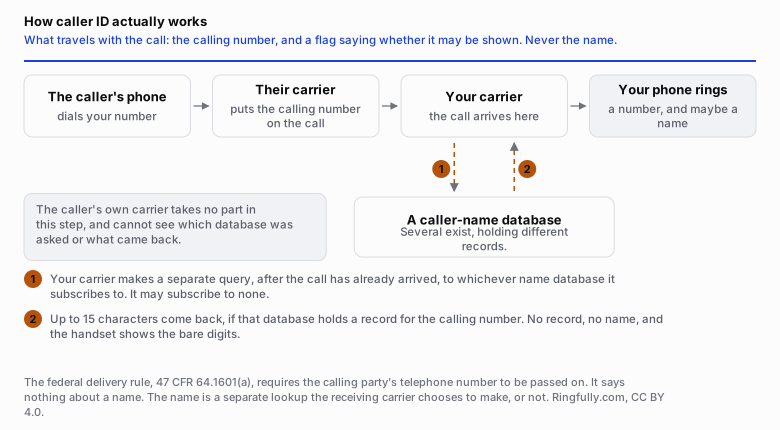
Two mechanisms, one screen. The number rides the call; the name is a separate query made after the call has already arrived.
Reuse this figure anywhere, including commercially, with credit to Ringfully and a link back to this page. CC BY 4.0.
Where the name comes from
When a call arrives, the carrier delivering it to your handset may make a second, entirely separate query: it takes the calling number, asks a caller-name database what name is on file for it, and puts whatever comes back on your screen.
Four consequences follow immediately, and between them they cover most of what people find strange.
It is optional. Each lookup costs the receiving carrier money, and some do not pay for them. A carrier that skips it shows the number alone, or the city and state the area code covers.
There is more than one database. Records are held in several places, maintained by different operators, and they do not agree with each other. Two carriers reading two databases can print two different names for the same call at the same moment.
The caller's carrier is not involved. Your provider files a record. It has no visibility into which database any given receiving carrier reads, or whether it reads one at all.
Records are only as fresh as whoever updates them. Nobody sweeps them for correctness. A name filed by a previous holder of the number can sit there for years.
You can see the shape of this in commercial terms too. Twilio's caller name lookup documentation notes that the service is "only available for phone numbers owned by carriers in the United States", and that a lookup "is billed per request, even if no data is returned". A paid query that can come back empty is not the description of a field travelling with a call. It is the description of a database somebody has to ask.
That is also the machinery behind every commercial lookup service, pointed the other way. What a caller ID lookup can tell you goes through what those queries genuinely return and what they only appear to.
Fifteen characters, in capitals
The name field holds at most 15 characters including spaces, and records are conventionally stored in capitals.
That limit is inherited. It comes from the era when caller ID was delivered to an analog phone as a burst of tones between the first and second ring, and the field it was carried in has never been widened. Everything since has been built to fit it.
Which means a business name longer than fifteen characters gets shortened by somebody, and if it is not you, it is whoever files the record. "Northside Family Dentistry" is 26 characters. Something has to give, and the version a stranger sees is worth choosing deliberately rather than discovering.
Why two phones in one room show different things
This is the question people find hardest to accept, and it is the direct consequence of everything above.
One call, arriving at two handsets on two different carriers, can produce two different displays, because each receiving carrier decided separately whether to look a name up and where. Neither result is wrong. Neither is fixable from the calling end.
Why your business name shows up wrong works through the practical version of this, including who to file a correction with and how long it actually takes to propagate.
What the number proves, and what it does not
It proves less than people assume, and this is worth being blunt about, because the assumption is expensive.
The number that arrives is a real number: it travels with the call and it is required to. What nothing in the mechanism does is confirm that the number belongs to the person speaking. The number presented is chosen by the originating side, which is legitimate and necessary in ordinary use, a business with twelve extensions presents one published number for all of them, and it is also what makes a displayed number unsuitable as proof of identity.
The practical rule that falls out: a number is a way to call somebody back, not a way to know who they are. If a call claims to be from your bank, hang up and dial the number on the card. That is not caution about a broken system; it is using the system for the thing it can do.
That same gap, worked at industrial scale, is why you get so many spam calls. What to do about them splits in two: how to block unwanted calls for the ones you never want to hear from again, and screening calls without missing customers for the harder version, where the filter has to let a first-time customer through.
The same limit applies in the other direction. A number that looks valid, is formatted correctly, and passes every check you can run from a keyboard may still not be a working line, which is why a valid number is not an active line.
What you can and cannot control
You control the number you present on outbound calls, and you can file a name record through the provider that serves that number.
You do not control whether a receiving carrier reads that record, which database it reads, how current that database is, or whether it applies a label of its own on top.
Any provider promising you a guaranteed display on every network is promising something that is not theirs to give. Four separate parties have to cooperate and you have a relationship with one of them.
What is worth doing instead:
- Pick a name that fits in fifteen characters and reads as you, not as an abbreviation somebody else chose in a hurry.
- File it once, through the provider that serves the number, and then check it from a couple of outside phones on different carriers a few weeks later.
- Present one number consistently. A business that calls from six different numbers is six unrecognised numbers, however good each record is.
- Treat the name as a courtesy, not a channel. Anything a customer actually needs to know belongs in what you say when they answer.
All of that concerns calls arriving. If your business also dials people who did not ask to hear from you, a separate set of rules applies to the number you present: the Do Not Call list explained covers what the registry is, what the Do Not Call rules ask of you covers the obligations that come with keeping a calling list, and how to scrub a calling list is the routine that keeps you inside them.
Ringfully presents your published number on outbound calls, and a name record is filed by hand as part of setting a number up, because numbers here are provisioned by a person rather than bought from a page. We will tell you what was filed and where, and we will not tell you what a stranger's carrier is going to do with it, because nobody can. If you want to know what that involves for your numbers, ask us.
Questions people ask
- Does the caller's name travel with the call?
- No. Only the number does, along with a flag saying whether it may be displayed. The name is fetched afterwards by the carrier receiving the call, out of a separate database, in a query the caller's own carrier takes no part in and cannot see. That single fact explains most of the confusing behaviour people notice.
- Why does my name show on some phones and not others?
- Because looking the name up is a choice each receiving carrier makes for itself, and it costs money per query. A carrier that pays for lookups shows a name. One that does not shows the bare number, or a city and state guessed from the area code. Neither is a fault, and neither is something the calling side can change.
- Why is caller ID always in capitals and so short?
- The field is capped at 15 characters, a limit inherited from the specification written for analog caller ID and never widened. Records are conventionally stored in capitals. So a fifteen-character name is what the whole system can carry, and anything longer has to be shortened by somebody, usually badly.
- Is the number shown on caller ID reliable?
- It is reliable as a number and unreliable as an identity. Federal rules require carriers to pass on the calling party's telephone number, and it does travel with the call. What no part of the mechanism verifies for you is that the number belongs to whoever is speaking, which is why a number alone should never be treated as proof of who is calling.
- Can I control what people see when I call them?
- You can control the number you present, and you can file a name record through the provider that serves your number. What you cannot control is whether any given receiving carrier reads that record, which database it reads, or how current that database is. Nobody controls those, which is why nobody can honestly guarantee the result.
About the author
John
Owner and CEO
Owner and CEO with over 10 years of experience in the IT industry, including more than 5 years specializing in VoIP and cloud communications. Experienced in designing, deploying, and supporting reliable communication solutions for businesses.

Keep reading
If unwanted calls are burying the ones from customers, or your own number shows up wrong when you call out, tell us which, and we will say what a phone system can change and what it cannot.