Blog
What do-not-call rules ask of your business
If you call people who did not ask to hear from you, five obligations apply: scrub, an internal list, relationship windows, calling hours and records.
John · Owner and CEO · 6 min read ·
Five things, if you call people to sell something. Synchronise your list with the national registry at least every 31 days. Keep your own do-not-call list forever. Respect the windows an existing relationship gives you. Call only between 8 a.m. and 9 p.m. where the person is. Keep records for two years.
This is a plain-language map of published rules, not legal advice. Every obligation below is stated by the regulator on its own pages, which are linked. For the wider ground, which recorded calls are lawful and where the legal line sits, start with what a robocall is.
Who this actually applies to
The rules attach to the activity. If your business places calls to people who did not ask to hear from you, in order to sell them something, you are inside the Federal Trade Commission's Telemarketing Sales Rule. Company size is irrelevant. Calling from a personal phone is irrelevant. Hiring a contractor to dial for you does not move the obligation off you, because the rules reach both the seller and the telemarketer.
What is outside: calls to your existing customers about something they already bought, calls returning an enquiry, and calls that are not trying to sell anything at all. Those still have to respect a direct request to stop.
Obligation one: scrub, at least every 31 days
You subscribe to the National Do Not Call Registry, download the numbers for the areas you call, and remove them from your list. The FTC's questions and answers for telemarketers and sellers is explicit about the interval: "you must synchronize your lists with an updated version of the registry at least every 31 days."
Data for up to five area codes is free. Beyond that the FTC charges an annual fee per area code, published on the same page.
The date you last synchronised matters as much as the act. It is the fact you will be asked for.
Obligation two: your own list, and it never expires
Separate from the national registry, you have to keep a company-specific do-not-call list: everyone who has asked your business directly to stop calling them. The FTC requires that a telemarketer honour a request to be placed on that seller's entity-specific list.
Three things make this the obligation that catches small businesses.
It has no expiry. A request from four years ago still stands.
It outranks everything else. Being an existing customer, or being inside a relationship window, does not put somebody back onto a callable list once they have asked you to stop.
And it is usually kept nowhere. A note in one person's head, or in a CRM field nobody else knows about, is the same as not keeping it when the person who took the request has left.
Obligation three: the relationship windows
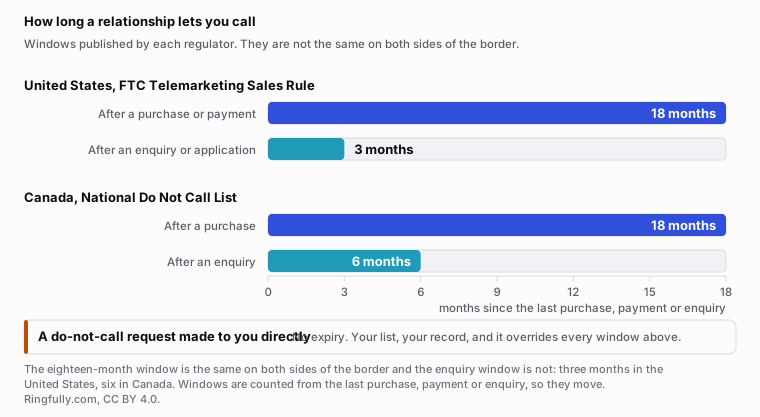
The eighteen-month window matches on both sides of the border. The enquiry window does not, and a request made to you directly outranks both.
Reuse this figure anywhere, including commercially, with credit to Ringfully and a link back to this page. CC BY 4.0.
An established business relationship lets you call somebody who is on the registry, for a while. The FTC sets the windows at up to 18 months following the person's last purchase, delivery or payment, and 3 months following an enquiry or application.
Two details do most of the damage in practice.
The clock runs from the most recent transaction, not the first one, so a customer's window quietly reopens every time they buy and quietly closes eighteen months after they stop.
And it is a window, not a permission. If they ask you not to call, the window ends that day.
There is also a separate route: written express agreement to receive calls from a named party. That is consent, it is stronger than a relationship window, and it has to actually exist in writing rather than as an assumption about a form somebody filled in.
Obligation four: hours, and what you say first
The FTC's guidance on complying with the Telemarketing Sales Rule sets permitted calling hours as no earlier than 8 a.m. and no later than 9 p.m. in the consumer's time zone. If you call from Denver to Boston, 7:30 in your afternoon is 9:30 in theirs, and that is a violation created entirely by a spreadsheet with no time zone column in it.
The same rule requires you to disclose promptly, before the pitch: the identity of the seller, that the purpose of the call is to sell goods or services, and what those are. It also treats failing to transmit caller ID information as prohibited conduct, so hiding your number is itself a problem.
Obligation five: records, for two years
The TSR requires specific business records to be kept for two years, including advertising and promotional materials, sales records, employee records, and records of express informed consent or verifiable authorisation.
This is where a compliance story either exists or does not. The safe harbour the FTC describes is built out of evidence: written procedures, training, monitoring, an internal do-not-call list, and having accessed the registry within the required window. None of that is provable from memory.
If you record calls as part of that evidence, note that recordings themselves become records with a lifespan and a cost. How much storage do call recordings need does the arithmetic before you turn recording on for a whole team.
Canada is a different rulebook
Canada operates its own National Do Not Call List, and the differences are small enough to be missed and large enough to matter. The published exemptions for organisations set the window after an enquiry at six months rather than three, put calls to business numbers outside the list, and require an exempt caller to identify itself and to honour an internal do-not-call request within fourteen days.
If you call into both countries, you are running two sets of rules against one list. Treat them as two, or you will apply the more permissive one by accident.
What this looks like for a five-person business
You do not need a compliance department. You need four artefacts and one habit.
- A single calling list that everybody works from, rather than four spreadsheets.
- A dated record of the last registry synchronisation.
- An internal do-not-call list somebody other than its author can find.
- A note of when each contact last bought or enquired, so a window can be checked rather than guessed.
The habit is doing the scrub on a schedule instead of before a campaign. The process, pass by pass, is in how to scrub a calling list.
For what the same registry looks like from the consumer's side, including what it does not cover, see the Do Not Call list, explained. The rest of the topic is in spam and call blocking.
If you are setting up outbound calling and want the call records and the list in one place rather than four, talk to us about how you are set up now.
Questions people ask
- Do the do-not-call rules apply to a small business?
- They apply to the activity, not to the size of the company. If you place calls to people who did not ask to hear from you, in order to sell something, the rules apply whether you are two people or two hundred. There is no small-business exemption to rely on.
- How often do I have to check the registry?
- The FTC states that a seller required to use the registry must synchronise its lists with an updated version at least every 31 days. Keep the date of each synchronisation, because the date is what evidences compliance later, not the fact that you have an account.
- Can I call an existing customer who is on the list?
- Within limits. The FTC allows calls within an established business relationship for up to 18 months after a purchase or payment, and for 3 months after an enquiry or application. Both windows run from the most recent one, and both end immediately if the person asks you to stop.
- What is an internal do-not-call list?
- Your own record of everyone who has asked your company directly not to call them. It is separate from the national registry, it does not expire, and it applies even to people you would otherwise be allowed to call. It is also the one most small businesses do not keep.
- When am I allowed to call?
- The FTC's guidance sets permitted hours as no earlier than 8 a.m. and no later than 9 p.m. in the person's own time zone, not yours. If you call across time zones from a single office, this is the rule most often broken by accident.
- What do I have to say when someone answers?
- Promptly, before any pitch: who the seller is, that the purpose of the call is to sell something, and what is being offered. The rule also treats failing to transmit caller ID information as a violation, so a call that hides its number is a problem before anybody speaks.
About the author
John
Owner and CEO
Owner and CEO with over 10 years of experience in the IT industry, including more than 5 years specializing in VoIP and cloud communications. Experienced in designing, deploying, and supporting reliable communication solutions for businesses.

Keep reading
If unwanted calls are burying the ones from customers, or your own number shows up wrong when you call out, tell us which, and we will say what a phone system can change and what it cannot.