Blog
The Do Not Call list, explained
How to register your number, what the list stops within 31 days, the long list of calls it never covered, and what the same registry asks of a business.
John · Owner and CEO · 5 min read ·
Register at donotcall.gov or by calling 1-888-382-1222 from the phone you want on the list. It is free, it covers cell phones, and it never expires. Sales calls from companies that follow the rules should stop within 31 days. Scams, charities, political calls and surveys will not.
Registering, in one minute
The Federal Trade Commission runs the National Do Not Call Registry, and its own registry FAQ is the clearest source on what registration does.
The mechanics are short. Register online or by phone, from the number itself if you call. Your number is on the list the next day. Sellers are given 31 days to pick it up, so the FTC says "it can take up to 31 days for sales calls to stop". Registration "will never expire": the FTC removes a number only when it is disconnected and reassigned, or when you ask.
Nobody needs to pay for this, and nobody needs to re-register. Any call or email offering to renew your registration is itself a sign of the thing you are trying to avoid.
What it stops, and what it never covered
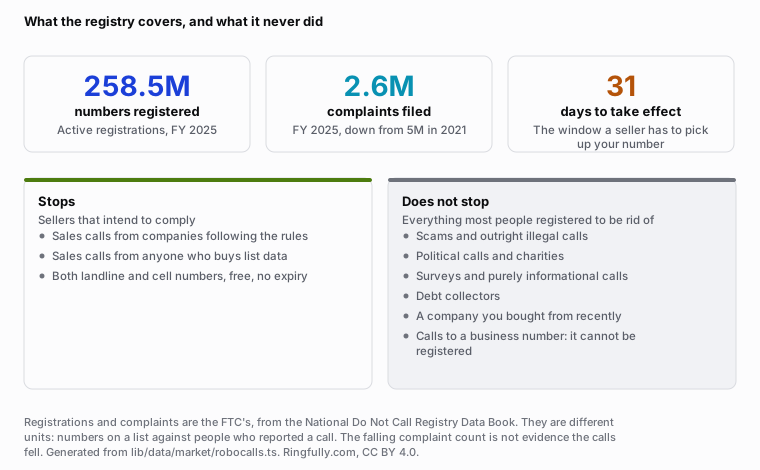
Registrations are numbers on a list. Complaints are people who reported a call. They are different units and neither is a count of calls.
Reuse this figure anywhere, including commercially, with credit to Ringfully and a link back to this page. CC BY 4.0.
It stops sales calls from companies that intend to comply, whoever they bought their list from. That is a genuine category and the registry handles it well.
It does not stop the following, and never did:
- Scams and other illegal calls. The FTC states it "won't stop calls from scammers making illegal calls".
- Political organisations and charities.
- Surveys, and purely informational messages with no sales pitch in them.
- Debt collectors.
- A company you have recently bought from or made an enquiry to, for a limited window.
- Anything arriving at a business number, because business lines cannot be registered at all.
That last point catches a lot of owners. Registering your shop's line does nothing, because the registry was written for personal numbers.
Why the calls did not stop
The registry is large and the calls are larger. The FTC's National Do Not Call Registry Data Book for fiscal year 2025 reports 258.5 million active registrations and 2.6 million complaints in the year, down from 5 million complaints in fiscal 2021.
Read those two numbers carefully, because they are not the same kind of thing. One counts numbers on a list. The other counts people who took the time to report something. Neither is a count of calls placed, which is a third quantity: the YouMail Robocall Index estimated 3.9 billion robocalls in the United States in August 2026 alone.
Put together, the honest reading is not that the problem improved. A falling complaint count against an unchanged call volume is at least as consistent with people giving up on reporting.
The deeper reason is structural. The registry governs callers who care about being lawful. It has no mechanism against callers who do not, and those callers place most of the calls. That is why why you get so many spam calls matters more, practically, than any list.
Reporting a call
Report at donotcall.gov: the number that called, the date and the time, and what it was about. Reports feed the FTC's own enforcement and the data other blocking services use.
It is worth doing and worth being realistic about. One report does not stop one caller. A pattern of reports is what makes a case possible.
What actually reduces the calls you get
Registration is step one of about four, and the other three do more. Screening before the phone rings, carrier labelling, and sending unrecognised numbers to voicemail all remove traffic that the registry cannot touch. They are ordered by effect, with the gap next to each, in how to block unwanted calls.
On a business line the calculation changes again, because every filter you add is also a filter on revenue, and what missed calls are actually worth is usually the larger number of the two.
If your business is the one calling
The same registry looks different from the other side, and if you make outbound calls to people who did not ask to hear from you, it is an obligation rather than a service.
In short: you have to synchronise your calling list with the registry at least every 31 days, you have to keep your own internal do-not-call list for anyone who asks you directly, there are limited windows during which an existing customer may still be called, and you have to keep records. The details are in what the do-not-call rules ask of you, and the process in order is in how to scrub a calling list.
Canada runs a separate list under its own rules, published by the National Do Not Call List, including a six-month window after an enquiry where the United States allows three. If you call into both countries, you have two sets of obligations.
None of this is legal advice. Each regulator publishes its own rules, and those pages are the ones to check before you dial.
Where to go next
- What a robocall is for the legal line between a reminder and a violation.
- How to block unwanted calls for the measures that outperform the registry.
- Screening calls without losing customers for the trade a business makes when it puts a step in front of the ring.
- Everything else in spam and call blocking.
If nuisance calls are eating a working day at your business and registering did nothing, that is expected, and we can look at what your line does before it rings.
Questions people ask
- How do I put my number on the Do Not Call list?
- Go to donotcall.gov, or call 1-888-382-1222 from the phone you want to register. It is free, it works for cell phones and landlines, and the FTC states that registration never expires. Your number goes on the list the next day and sellers have 31 days to act on it.
- Does registering stop all unwanted calls?
- No. It stops sales calls from companies that intend to follow the rules. The FTC says plainly that it will not stop calls from scammers making illegal calls, and the registry never covered political calls, charities, surveys, debt collectors or purely informational messages.
- How long does the Do Not Call list take to work?
- Your number is on the registry the next day, and the FTC says it can take up to 31 days for sales calls to stop, because that is how often a seller has to synchronise its calling list with the registry. If compliant sales calls continue after that, you can report them.
- Does registration expire?
- No. The FTC removes a number only if it is disconnected and reassigned, or if you ask for it to be taken off. There is no renewal, and any service offering to re-register your number for a fee is selling you something you already have for nothing.
- Can I register a business number?
- No. The registry is for personal numbers. Business lines and fax lines are not covered, which is why registering does nothing about the sales calls arriving at your shop or clinic. For a business line, screening and carrier labelling are the tools that exist.
- Is Canada's list the same thing?
- No. Canada runs its own National Do Not Call List with different rules, including a different window after an enquiry: six months rather than the three months in the United States. If you call people in both countries you have two sets of obligations, not one.
About the author
John
Owner and CEO
Owner and CEO with over 10 years of experience in the IT industry, including more than 5 years specializing in VoIP and cloud communications. Experienced in designing, deploying, and supporting reliable communication solutions for businesses.

Keep reading
If unwanted calls are burying the ones from customers, or your own number shows up wrong when you call out, tell us which, and we will say what a phone system can change and what it cannot.