Blog
Why you get so many spam calls
Spam calling is cheap, and the phone number is the disposable part. Why the volume is what it is, why blocking never catches up, and what actually helps.
John · Owner and CEO · 5 min read ·
Because it is cheap, and because the phone number it shows you costs the caller almost nothing to throw away. A campaign is not trying to reach you specifically. It is placing enough attempts that a very small response rate still pays, and the number on your screen is a rented wrapper it expects to lose.
The arithmetic that makes it worth doing
Placing a call over the internet costs a fraction of a cent. That single fact explains most of what follows.
If a thousand attempts cost less than a coffee, a campaign does not need to be persuasive. It needs to be large. A response rate that would embarrass any honest marketing department is still profitable at that price, which is why the volume looks irrational and is not.
The YouMail Robocall Index put the United States at 3.9 billion robocalls in August 2026, about 125.4 million a day, published monthly at robocallindex.com. That estimate comes from extrapolating YouMail's own user data rather than measuring the network, and it counts calls placed, which is a different quantity from the complaints regulators receive.
The number is rented, not owned
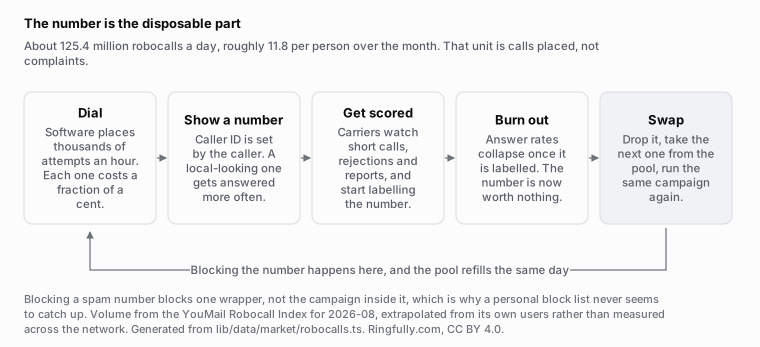
Blocking a spam number blocks one wrapper. The campaign inside it takes the next number from the pool the same day.
Reuse this figure anywhere, including commercially, with credit to Ringfully and a link back to this page. CC BY 4.0.
Your business has one published number and treats it as an asset. A spam campaign holds a pool of numbers and treats each one as ammunition.
The cycle is short. Dial from a fresh number. Get whatever answer rate a local-looking caller ID buys. Accumulate the pattern that gives it away: very short calls, high rejection, user reports. Carrier analytics score that behaviour and the number starts being labelled on the receiving handset. The answer rate collapses within days. Drop it, pick up the next one, run the same script.
Every consumer instinct about spam calls assumes the number identifies the caller. It does not. It identifies which wrapper the campaign was using this morning.
Why it looks like a neighbour
Caller ID is supplied by the caller. That is not a loophole somebody found, it is how the field works, and it is why the FTC's guidance on phone scams says flatly: "Scammers can make any name or number show up on your caller ID. That's called spoofing."
Choosing a number that matches the first six digits of yours raises the answer rate, because it reads as the school, the pharmacy or somebody in town. The FTC's page on blocking unwanted calls names the same practice and notes that not every scam call gets flagged.
This has a practical consequence that matters more than the annoyance: a local prefix is not evidence of anything. If you have ever taken a call because it looked like a local number, you have already paid for that assumption. The same is true in reverse, and it is why a valid number is not an active line is worth reading before you trust any number on a screen.
What the carriers are actually doing
Phone companies do not read the content of calls. They watch behaviour and they score numbers, then they either label the call on the way to your handset or block it before it rings.
That approach has one structural weakness, and it is the reason the problem persists. Scoring needs history, and a number used for the first time this morning has none. The system is very good at recognising a number that has already misbehaved and blind to the one that has not started yet. Since numbers are cheap and disposable, the campaign lives permanently in that blind spot.
Labelling also produces false positives, and small businesses feel those. A new number, a burst of outbound calls to people who do not recognise it, and a lot of short conversations is the same shape as a campaign. There is no manual review before a label appears.
What actually reduces what reaches you
Three things do real work, and they are not the three most people try.
Screening before the phone rings. A greeting that asks the caller to press a key removes automated traffic, because automated traffic does not press keys. It costs you some real callers, which is the trade covered in screening calls without losing customers.
Registering on the Do Not Call list, for what it is worth. It stops sales calls from companies that intend to comply. That is a real category and it is not the category you are complaining about. The Do Not Call list, explained is honest about the boundary.
Letting the ones you do not recognise go to voicemail. Unsatisfying, effective, and cheap. The cost is the first-time customer who will not leave a message, which is a real cost worth measuring rather than assuming.
What does not work, in order of how often it is tried first: blocking each number, asking an illegal caller to remove you, and answering in the hope of finding out who it was.
The one number worth checking
Call your own published number from an outside line, on a phone that is not in your address book, every few months. Look at what it says before it rings.
If your number has picked up a label, your outbound calls are being declined by people who were expecting you. That is a quieter and more expensive problem than the calls arriving at your desk, and almost nobody checks for it.
The rest of this topic sits in spam and call blocking, starting with what a robocall is. If your number is being labelled and you are not sure why, tell us what is happening and we will look at it with you.
Questions people ask
- Why do I suddenly get more spam calls than I used to?
- Usually because your number reached more lists, and because attempting a call costs almost nothing. Placing a thousand calls is a rounding error on a phone bill, so the campaign is worth running even when almost nobody engages. Volume is the strategy rather than a side effect.
- Why does the caller ID show my own area code?
- Because caller ID is chosen by the caller, and a local-looking number gets answered more often. The FTC calls the practice spoofing and says plainly that any name or number can be made to appear. A local prefix tells you nothing about where the call came from.
- Why does blocking the number not stop them?
- The number is rented, not owned. A campaign dials from a number until carrier scoring labels it and the answer rate collapses, then drops it and takes the next one from a pool. Blocking removes one wrapper from a pool that refills the same day.
- Does answering and asking to be removed make it worse?
- For a legitimate company, asking to be removed works and they have to honour it. For an illegal campaign, answering confirms a live person is on the line, which is worth more to them than the call cost. The safe rule with a recorded sales pitch is to hang up.
- Why does my own business number get flagged as spam?
- Carrier analytics score behaviour rather than intent. Short calls, unanswered bursts and a number with no history all look like a campaign. A new number used for outbound calls can pick up a label without anybody doing anything wrong, which is why it is worth checking what your number displays.
About the author
John
Owner and CEO
Owner and CEO with over 10 years of experience in the IT industry, including more than 5 years specializing in VoIP and cloud communications. Experienced in designing, deploying, and supporting reliable communication solutions for businesses.

Keep reading
If unwanted calls are burying the ones from customers, or your own number shows up wrong when you call out, tell us which, and we will say what a phone system can change and what it cannot.