Blog
Screening calls without losing customers
Every notch of call screening buys quiet and costs callers. How to pick the setting your business can afford, and how to tell whether it went too far.
John · Owner and CEO · 6 min read ·
Filter on behaviour, not identity. A greeting that asks the caller to press one key removes almost all automated traffic, because a dialler will not press it, while a person who wants to reach you will. Anything tighter starts costing you customers faster than it buys quiet, and the loss never shows up on a report.
Screening filters on one of two things
Every method of keeping unwanted calls away from your team is filtering on either who is calling or how they behave, and the difference decides what it costs you.
Filtering on identity means blocking unknown numbers, withheld caller ID, or numbers that a scoring service has labelled. It is cheap to turn on. It fails against a brand new spam number, and it fails against a new customer, who is by definition unknown.
Filtering on behaviour means asking the caller to do something a machine will not do: press a key, choose from two options, say why they are calling. It works against a number nobody has ever seen, which identity filtering cannot do, and it turns away only people unwilling or unable to take that step. The machine on the other side is a dialler playing a recording, and what a robocall is covers which of those calls are lawful and which are not.
For a business that wants new customers, behaviour filtering is almost always the right instrument. The rest of this article is about how hard to turn it.
The trade, drawn
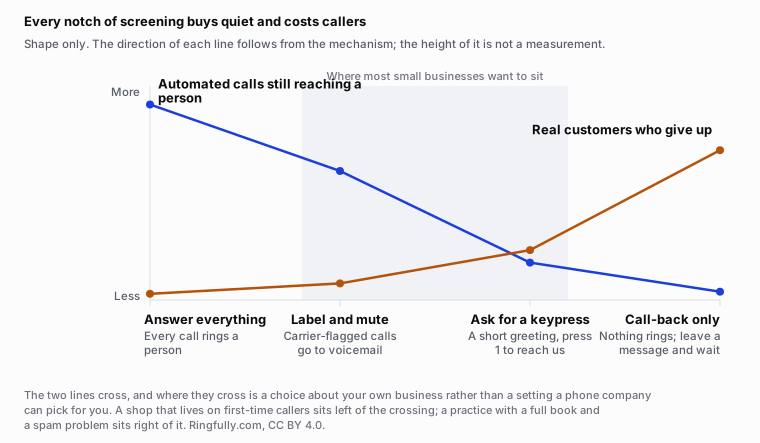
The two lines cross. Where they cross is a decision about your own business, not a setting a phone company can pick for you.
Reuse this figure anywhere, including commercially, with credit to Ringfully and a link back to this page. CC BY 4.0.
That figure is a shape, not a measurement, and it is drawn that way on purpose: the direction of each line follows from the mechanism, and anybody quoting a precise number for how many customers a prompt costs you is quoting their own business, not yours.
The claim in it is only this. Tightening the gate always removes automated calls and always removes some real ones, the second effect accelerates as you tighten, and there is a point where an extra notch costs more than it saves.
The four settings, and who each suits
Answer everything. Every call rings a person. Right for a business with low call volume where a single new customer covers a week of interruptions, and for anyone whose number is not yet on many lists. It is also the setting that quietly burns a receptionist's day once the volume arrives.
Label and mute. Let the carrier's scoring send flagged calls to voicemail and leave everything else alone. It costs almost nothing in lost callers, and it will not stop the fresh numbers that make up most of the problem. A reasonable default that nobody should mistake for a fix.
Ask for a keypress. A short greeting, then one key to reach a person. This is where most small businesses should sit. It removes essentially all automated traffic. It costs you the caller who is driving, the caller on a bad line, and the caller who is impatient enough to try a competitor instead. Keep the greeting under about eight seconds and put the option in the first sentence, because the people who hang up mostly do it before they hear the choice.
Call-back only. Nothing rings, everyone leaves a message. Right when your book is genuinely full and wrong almost everywhere else. This is not screening any more, it is a decision to stop taking phone business, and it should be made on purpose rather than arrived at by adding one more filter.
What a lost caller is worth
This is the number that decides everything above, and most owners have never worked it out.
Take the value of an average job, multiply by the share of first-time callers who become customers, and you have the cost of one caller who gave up. Against that, put the time your team loses to nuisance calls. What missed calls are actually worth walks through the arithmetic with real inputs, and for most service businesses the missed-call side is larger by a wide margin.
There is a second reason to be careful, and it is not your fault. Consumers are being told, correctly, to be suspicious of calls they do not recognise. The FTC's advice on blocking unwanted calls walks people through silencing unknown callers, and its robocalls page tells them to hang up on recorded messages. Your outbound call to a customer who does not have you saved is being screened by the same instinct. Adding a gate to your inbound line while your outbound calls are already being filtered narrows the channel from both ends.
How to set it, in practice
- Start one notch looser than feels right. You can tighten in a week. You cannot recover the caller who tried you on Tuesday.
- Put the escape route first. "Press 1 to speak to somebody" belongs in the first sentence, not after your hours and your website address. Six phone messages every business needs has the wording for the ones that carry weight.
- Never make a caller press a key twice. One decision is a filter. Two is a maze.
- Have somewhere for the calls to land when everyone is busy, because a screening gate does not create capacity. Missed calls while everyone is busy is the other half of this problem.
Tell whether it worked with two numbers
Calls ending in under ten seconds. These are people who reached the gate and left. Watch the count before and after any change to the greeting. A rise means the gate is costing you.
Calls answered by a person. If nuisance calls fall and answered calls fall by a similar amount, you did not filter anything, you just made the phone harder to use.
Look at both together, monthly. One without the other will tell you a comforting story.
What not to do
Do not block withheld numbers. Do not add a second menu because the first one leaked something through. Do not set the gate tight during your busiest week and then leave it there, which is how most businesses end up on the far right of that figure without ever choosing to be.
And do not screen your way out of a staffing problem. If the phone is unbearable because three people are covering ten people's calls, screening will make the reports look better and the business worse.
The rest of this topic sits in spam and call blocking. If you are weighing what a screening step would cost against what it saves, our pricing is per seat with the minutes included, which makes the comparison against a lost job easy enough to do on paper.
Questions people ask
- Does call screening lose customers?
- Yes, and the loss is invisible, which is what makes it dangerous. A caller who hangs up at a screening prompt leaves no voicemail and no record beyond a very short call. The question is never whether screening costs callers, it is how many, and whether the quiet is worth more.
- What is the mildest screening that still works?
- A greeting of a few seconds asking the caller to press one number. Automated dialling does not respond to it, so it removes most of the nuisance traffic, and a person who wants to reach you presses the key. It is the best ratio of calls removed to callers lost.
- Should I block anonymous or unknown callers on a business line?
- No. Unknown is exactly what a new customer looks like, and plenty of people withhold caller ID by default or call from a hospital, a hotel or a work switchboard. Filter on behaviour, which a dialler fails, rather than on identity, which real customers fail.
- How do I tell whether my screening is too tight?
- Count calls that ended in the first ten seconds, month over month. A rise in very short calls after a change means people are reaching the gate and leaving. Compare that against the drop in nuisance calls and decide with two numbers rather than an impression.
- Is a callback-only setup ever right?
- Only when your customers already expect it, as with a practice whose book is full or a trade that quotes from a form. If a first-time caller is worth real money to you, taking the phone off the table entirely is the most expensive filter available.
- Does screening protect my own number from being labelled?
- No. Inbound screening and outbound labelling are separate problems. Your number gets scored on the behaviour of the calls you place, so the fix there is fewer unanswered bursts and a number your customers recognise, not a tighter gate on the way in.
About the author
John
Owner and CEO
Owner and CEO with over 10 years of experience in the IT industry, including more than 5 years specializing in VoIP and cloud communications. Experienced in designing, deploying, and supporting reliable communication solutions for businesses.

Keep reading
If unwanted calls are burying the ones from customers, or your own number shows up wrong when you call out, tell us which, and we will say what a phone system can change and what it cannot.