Blog
A valid number is not an active line
Format checks prove a number is written the way its country writes numbers. They never prove it rings. What to check before a CRM import, and what not to claim.
Owner and CEO · 4 min read ·
A format check proves a phone number is written the way its country writes numbers. It never proves the number rings. Those are two different questions, only the first one is free, and confusing them is how a migrated contact list looks clean and reaches nobody.
What a numbering plan actually says
Every country publishes a numbering plan: a document saying how the digits of a phone number there are arranged. How many digits. Which ones may come first. What is dialled inside the country and dropped outside it.
In the North American plan the rule is short. Ten digits, written NXX-NXX-XXXX, where N is any digit 2 to 9 and X is any digit 0 to 9, with the 1 in front being the long-distance prefix rather than part of the number. So 514 555 0123 is arranged correctly and 514 055 0123 is not, because an exchange code may not start with zero.
That is the whole of what such a check can tell you. It is genuinely useful, it catches real errors, and it stops at the edge of the document.
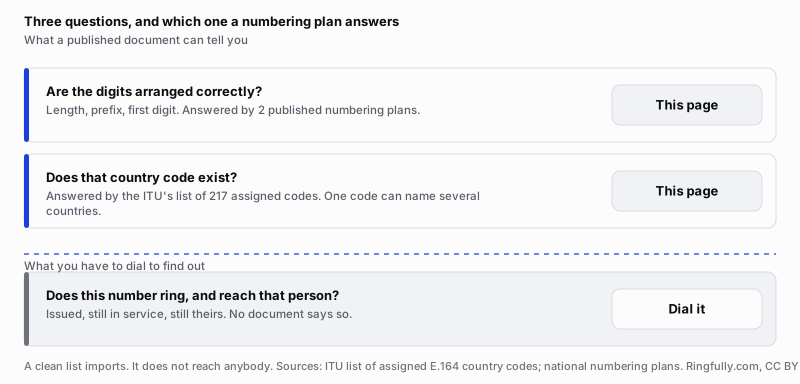
The first two questions are answered by published documents. The third one is not, and no amount of checking moves it above the line.
Reuse this figure anywhere, including commercially, with credit to Ringfully and a link back to this page. CC BY 4.0.
The three questions people mean by "is this number good"
Are the digits arranged correctly? A published plan answers it.
Does that country code exist? The ITU's numbering recommendation and its list of assigned country codes answer it. Worth knowing: a country code is not a country. The code 1 covers twenty-five countries and territories, so a number beginning +1 441 is Bermudian even when it turns up in a Quebec spreadsheet.
Does this number ring, and reach the person written next to it? Nothing published answers that. The number may never have been issued. It may have been given up in 2019. It may belong to somebody who is now getting your calls. The only place that answer exists is with the carrier holding the number, and getting it means dialling or paying somebody to dial.
Google's libphonenumber, which is the reference implementation almost every one of these tools is built on, says the same thing in its own documentation. It is not a caveat somebody buried. It is the first thing the library tells you about itself.
What to do before an import
Three things, in this order.
- Get everything into one format. E.164: plus, country code, national number, no punctuation. Our phone number cleaner does this in the browser with nothing uploaded, and it reports every row it will not convert rather than guessing.
- Choose the country deliberately, once. Not per row, not automatically. If your list is Canadian, say so and let the rows that do not fit come back to you. Those rows are the interesting ones: they are usually a supplier abroad, a typo, or somebody's cell number from another country.
- Keep every other column. The customer id and the name are what let you match a cleaned row against the row it came from. A cleaner that hands back one column of numbers has handed back something nobody can reconcile.
Then treat the result as clean data, not as reachable data. If reaching people matters, the check for that is a phone call.
The claim to stop making, and what to do instead
"Verified", "validated" and "checked" all suggest something was confirmed against reality. Nothing was. What was confirmed is that a string matches a document.
This matters commercially, not just semantically. A sales team told a list is verified works it as though every number rings, and blames the list when a third of the calls go nowhere. A team told the list is correctly formatted but of unknown age plans for that. Same file, two very different quarters.
It also matters if you are moving providers. A number that a format checker reads happily is not automatically a number you can take with you: porting has its own rules and its own paperwork, and eligibility has nothing to do with whether the digits parse.
Format checking is worth doing, costs nothing, and should be honest about its own limits. Anything that promises more than a numbering plan can support is selling you a certainty it does not have.
If you want the numbers themselves to start behaving once they are clean, that is a different piece of work: what happens when somebody calls back, who takes which call, and what a caller hears while everyone is busy. Our pricing is per seat with minutes included and a spend ceiling on every plan, so a badly cleaned list cannot turn into a surprise bill either.
Questions people ask
- Does a valid phone number mean the line is active?
- No. Validity here means the digits are arranged the way the published numbering plan for that country says a number is arranged: the right length, an allowed first digit, the right prefix. It says nothing about whether that particular number was ever issued, is still in service, or still belongs to the person beside it in your spreadsheet. A number can be perfectly formed and ring nowhere.
- What is E.164 format?
- A plus sign, then the country code, then the national number with no spaces, brackets, dashes or leading trunk digit, up to fifteen digits in total. (514) 555-0123 in Montreal becomes +15145550123. It is what most phone systems and CRMs mean when they ask for international format, and it is unambiguous in a way a locally written number is not.
- Why can a tool not work out which country a number belongs to?
- Because a locally written number carries no country code, so the information simply is not there. The same ten digits are a Montreal number in a Canadian list and something else entirely in a list from elsewhere. A tool that picks one for you is guessing, and a wrong guess produces a plausible-looking number that quietly fails months later. Choose the country yourself, one setting for the whole list.
- How do I actually find out whether a number still works?
- Dial it, or pay a service that dials it for you. Those checks exist, they cost money per number, and their coverage varies by country and carrier. There is no free offline way to know, because the answer lives with the carrier holding the number and not in any published document. Budget for it as a separate step, or accept that some of your list is stale.
