Blog
How to scrub a calling list
Seven passes in order: normalise, drop what is out of scope, scrub the registry, apply your own list, check the windows, gate on local time, record it.
John · Owner and CEO · 5 min read ·
Seven passes, in this order: normalise the list, drop what is out of scope, scrub against the national registry with data no more than 31 days old, apply your own do-not-call list, check the relationship windows, gate on the caller's local time, and write down what you did. Order matters more than tooling.
Before you start: one list, not five
Almost every problem in this process is really a problem of having four spreadsheets.
Merge first. One row per number, one format, one owner. If two versions of the list exist after the scrub, the untouched one will be the one somebody dials from in three weeks, and the scrub might as well not have happened.
While you are merging, put the number into a single canonical form. A list with (555) 010-1234, 555.010.1234 and +15550101234 in it will not deduplicate, and it will not match cleanly against registry data either. Note also that a well-formed number is not the same as a reachable one: a valid number is not an active line explains why a clean-looking list can still be half dead. If you are not yet sure which of your calls the rules reach at all, what a robocall is separates the recorded call that needs written permission from the one that does not.
The seven passes
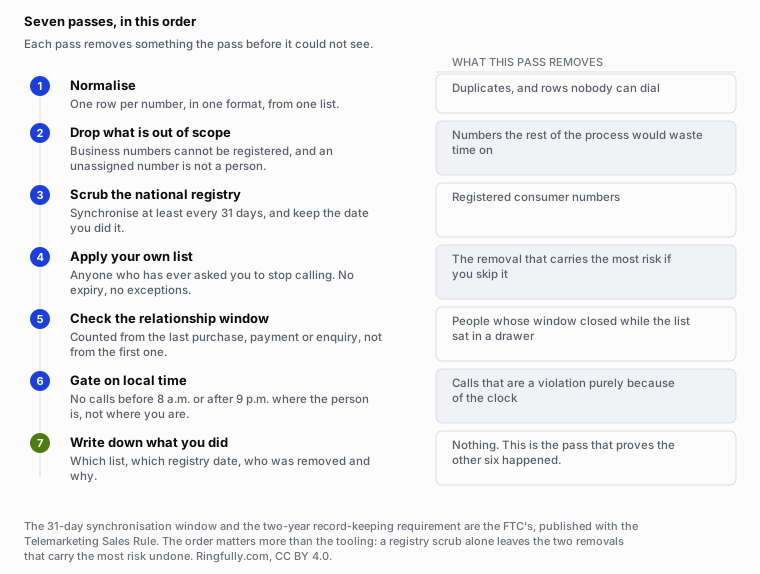
Each pass removes something the pass before it could not see. A registry scrub alone leaves the two riskiest removals undone.
Reuse this figure anywhere, including commercially, with credit to Ringfully and a link back to this page. CC BY 4.0.
1. Normalise. One row per number, one format. Removes duplicates and rows nobody can dial.
2. Drop what is out of scope. Business numbers cannot be registered on the consumer registry, so a scrub will not touch them, and they usually do not belong in a consumer campaign anyway. Unassigned and disconnected numbers are not people either.
3. Scrub the national registry. Download current data for the area codes you call and remove every match. The FTC states in its questions and answers for telemarketers and sellers that you "must synchronize your lists with an updated version of the registry at least every 31 days". Record the date you did it.
4. Apply your own list. Everyone who has ever asked your company directly to stop calling. No expiry, no exceptions, and it applies even to people the earlier passes would have left in.
5. Check the relationship window. An existing relationship allows calls for up to 18 months after a purchase or payment and 3 months after an enquiry, counted from the most recent one. A contact whose window closed while the list sat in a folder is not callable because they used to be.
6. Gate on local time. No calls before 8 a.m. or after 9 p.m. in the person's time zone. If your list has no time zone column, this pass is impossible and the violations are accidental, which does not help.
7. Write down what you did. Which list, which registry data and when, who was removed and why. This pass removes nothing and is the only reason anyone will believe the other six happened.
The registry account, and what it costs
You need an account before you can download anything. The FTC's fee schedule, on the page above, makes data for up to five area codes free, and charges an annual fee per area code beyond that: from 1 October 2025, $82 per area code of data, up to a maximum annual fee of $22,626. Organisations the rules exempt access the data without charge.
For a local service business calling one metro area, this usually lands inside the free allowance. For anyone calling nationally, it is a real line item and worth knowing before a campaign is planned around it.
The pass everybody skips
Pass four. Every time.
The registry scrub feels like the compliance step because it has an account, a download and a receipt. The internal list is a spreadsheet in somebody's folder, and it is the one that carries more risk, because those people did not opt out in the abstract. They told you.
Two habits fix it. Give the internal list one home that is not a person's inbox, and add to it the same day a request comes in rather than at the end of a week. If your phone system logs calls and notes centrally, the note belongs there rather than in a private CRM field, so the next person can find it.
How often, and when
Monthly, on a fixed date, whether or not a campaign is planned. Scrubbing before a campaign sounds more efficient and produces the classic failure: the campaign slips two weeks, the data ages past 31 days, and the calls go out against a list that no longer complies.
If you buy or import a list, scrub it on arrival and again on the normal cycle. A vendor's scrub is their record, not yours.
The whole routine, for a small team
- First working day of the month: pull registry data for your area codes, run passes one to three, and note the date.
- Same session: apply the internal list and the relationship windows, passes four and five.
- Export the callable list with a time zone column, so pass six is a sort rather than a judgement call.
- Save the before-and-after lists and the removal reasons where they will still exist in two years.
That is under an hour a month for most small businesses, and it is the difference between a defensible process and an anecdote.
For the obligations that sit behind each pass, see what the do-not-call rules ask of you. For the consumer side of the same registry, see the Do Not Call list, explained. The rest of the topic is in spam and call blocking.
If outbound calling is becoming a real part of how you sell, the phone system it runs on is worth costing properly: our pricing is per seat with the minutes included and a spend ceiling, which keeps a campaign from turning into a surprise bill.
Questions people ask
- How often does a calling list need scrubbing?
- At least every 31 days against the national registry, which is the interval the FTC sets for synchronising your lists. In practice, scrub on a fixed monthly date rather than before each campaign, because a campaign that slips by a week is how a list goes stale without anyone noticing.
- What does access to the registry cost?
- Data for up to five area codes is free. The FTC's published schedule sets an annual fee per area code beyond that: from 1 October 2025, $82 per area code of data up to a maximum annual fee of $22,626. Exempt organisations access it without charge.
- Can I just buy a scrubbed list from a data vendor?
- You can buy a list, but you cannot buy the obligation away. The duty to synchronise, to apply your own do-not-call list and to keep the records sits with you and with anyone dialling on your behalf. A vendor's scrub date is not a substitute for your own record of one.
- Which pass do people most often skip?
- Their own internal do-not-call list. The national scrub feels like the compliance step because it involves an account and a download, while the internal list is a spreadsheet somebody keeps in their own folder. The internal one carries more risk, because those people asked you directly.
- Do I need to remove business numbers?
- They cannot be registered on the consumer registry, so a scrub will not remove them and they are outside that particular rule. They still need to come out of a consumer campaign for a simpler reason: calling a switchboard with a consumer pitch wastes the call and annoys the recipient.
- What do I keep after a scrub?
- The date of the synchronisation, which registry data you pulled, the list before and after, and the reason each number was removed. The FTC requires specific records to be kept for two years, and a safe harbour claim is assembled out of exactly this kind of evidence.
About the author
John
Owner and CEO
Owner and CEO with over 10 years of experience in the IT industry, including more than 5 years specializing in VoIP and cloud communications. Experienced in designing, deploying, and supporting reliable communication solutions for businesses.

Keep reading
If unwanted calls are burying the ones from customers, or your own number shows up wrong when you call out, tell us which, and we will say what a phone system can change and what it cannot.