Blog
What is VoIP, and how does it work?
VoIP carries a call as data over the internet instead of a copper pair. What it replaces, what your network has to do, and what it changes about your phones.
John · Owner and CEO · 6 min read ·
VoIP is voice carried over an internet connection instead of a dedicated copper pair. Your speech is turned into data, cut into small packets, addressed, and sent across the same connection your email uses. The number, the ringing and the transfer all survive. What changes is what carries them, and what can go wrong.
This is the overview. Each section below has a longer article behind it if you want the detail.
What VoIP replaces
A traditional business line is three things you never see separately, because one company sold you all three.
There is the line: a physical pair of wires from your building to a telephone exchange, reserved for you whether you are talking or not. There is the switch: the equipment that decides where a call goes, which for a business with several extensions meant a box on the wall in a back room. And there is the carrier: the company that connects your call to everybody else's phone.
VoIP separates them.
The line becomes your existing internet connection, shared with everything else. The switch becomes software, usually running in a data centre rather than in your building. The carrier is still a carrier, because the person you are calling may well still be on a copper line or a cell phone, and something has to hand the call across.
That separation is the whole reason VoIP behaves differently. When the switch is software that somebody else runs, changing how your phone answers is a settings change rather than a service call. When the line is shared, a call competes with a file upload. Both of those follow from the same architectural move.
If you are weighing the two side by side rather than reading about the mechanism, VoIP against a landline for a business compares them on the things an owner actually feels, and VoIP against a traditional PBX does the same for the box in the back room.
What has to be true of your network
Three things, in descending order of how often they are actually the problem.
Steady delivery. Voice is a real-time stream. A packet that arrives late is worse than useless, because the moment it was meant to fill has already passed. This is the constraint that people underestimate, and it is why a connection with capacity to spare can still produce calls that sound chopped. How a VoIP call actually travels is the mechanism, and it explains why latency and jitter, not megabits, are the numbers that decide a call.
Enough room going out. A conversation sends one audio stream in each direction, so the upload and download requirements are identical in size. What is not identical is what you bought: most business connections carry far less going out than coming in, so upload is what runs out first. How much bandwidth does VoIP need does the arithmetic, headers included.
A path that is not blocked. Setting up a call and carrying its audio are two different conversations over two different protocols, and they do not take the same route. That is why the classic VoIP failure is a call that rings perfectly and then has no sound in it. The signalling got through. The audio did not.
Wired beats wireless for phones, every time, and it is the cheapest variable to remove from a call-quality argument.
How common this already is
VoIP is not an emerging option in the United States. It is what most wired phone lines already are.
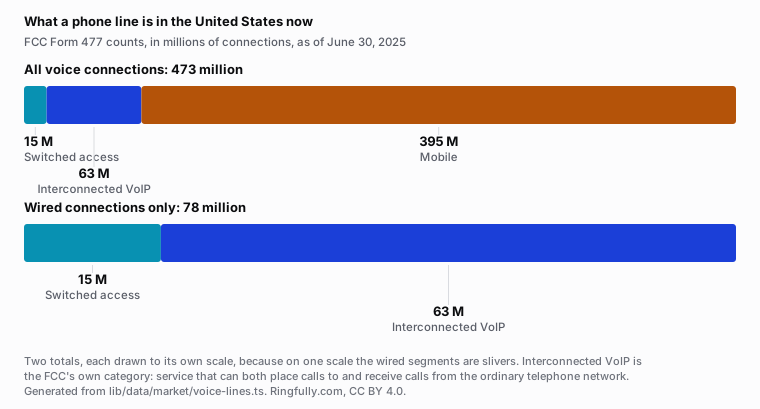
The FCC's own count of what a phone line is in the United States now. Among wired lines, VoIP outnumbers copper four to one.
Reuse this figure anywhere, including commercially, with credit to Ringfully and a link back to this page. CC BY 4.0.
The Federal Communications Commission counts voice connections twice a year through Form 477. As of 30 June 2025 it reported roughly 63 million interconnected VoIP connections against roughly 15 million traditional switched access lines, with about 395 million mobile subscriptions alongside them, out of a published total of about 473 million. Those figures are in the FCC's Voice Telephone Services report, which publishes the definitions with the counts.
"Interconnected VoIP" is the regulator's term for VoIP service that can both place calls to and receive calls from the ordinary telephone network. It is the category almost every business phone service falls into, and the four-to-one margin over copper is the number worth carrying away.
What VoIP changes about how a phone behaves
The technical shift is mildly interesting. The behavioural shift is the reason anyone moves.
A number stops being tied to a place. On copper, the number arrives at a building. On VoIP it arrives at whoever is signed in, which may be a desk phone in the office, a browser tab at home, or both ringing at once. That is also the point where owners ask whether they need a phone system at all, since everyone already carries a mobile: VoIP against cell phones for a business is that argument, and it turns on shared numbers rather than on call quality.
Adding a person stops being a site visit. It is an account and a device that registers itself.
And what happens before a human is involved becomes yours to set. Hours, holidays, a menu, what a caller hears when nobody is free: those are settings rather than a service request. If you have ever had to call the phone company to change a greeting, that is the difference that will actually be felt.
What it does not fix
VoIP moves the call onto a different transport. It does not answer the phone.
If calls currently ring out because everybody is with a customer, they will still ring out. If the transfer loses people, it will still lose people until somebody decides what a transfer should do. The technology changes what is possible to configure. It does not decide what should happen, and most of the complaints owners have about their phones are complaints about decisions nobody made.
It also introduces a dependency you did not have before. A copper line drew its own power from the exchange and kept working in a blackout. A VoIP call needs your internet connection and your electricity, and when either stops, so do the calls. That is a real trade, and the answer is not to pretend otherwise: it is to decide in advance where calls go when your office is unreachable. Does VoIP work without internet sets out what survives an outage and what has to be configured before one.
The rest of this cluster
- VoIP meaning, in plain English if you just want the acronym decoded.
- What is a VoIP phone for the physical object on the desk, and whether you need one.
- What is VoIP phone service for what you actually buy and what the bill covers.
- How a VoIP call actually travels for signalling, media, latency and jitter.
- Types of VoIP phone systems for hosted against on-premise against hybrid.
- Everything else in VoIP basics.
When you get to the point of comparing what any of it costs, our pricing is per seat with the minutes included and a spend ceiling on every plan, which is the shape worth comparing against whatever quote you are holding.
Questions people ask
- What does VoIP actually do?
- It turns speech into data, cuts that data into small packets, and sends them across an internet connection to the far end, where they are turned back into sound. The phone number, the ringing, the hold and the transfer all still exist. What changes is that the call rides on the same connection as everything else in the office rather than on a pair of wires dedicated to it.
- Do I need special internet for VoIP?
- No, but you need a connection with enough room going out at your busiest moment, and one that delivers packets steadily. A single G.711 call is about 87 kilobits a second in each direction with headers counted. Capacity is rarely the problem in a small office. Delay and unsteady delivery usually are, and those are not the numbers a speed test shows you.
- How common is VoIP in the United States now?
- By the FCC's own count, as of 30 June 2025 there were about 63 million interconnected VoIP connections in the United States against about 15 million traditional switched access lines. Among wired business and home phones, VoIP is no longer the alternative. It is the majority.
- Does my phone number change if I move to VoIP?
- It does not have to. A number can be ported from the carrier that holds it today to a VoIP provider, and callers notice nothing. Porting is a paperwork exercise with a schedule, not a technical one, and the details on the request have to match the losing carrier's records exactly or it is rejected.
- What happens to VoIP calls when the internet goes down?
- Calls in progress drop, and no new ones arrive at that office. What a good setup does is decide in advance where those calls go instead: to voicemail, to a cell phone, to a recorded message. The failure is unavoidable. Being surprised by it is not.
About the author
John
Owner and CEO
Owner and CEO with over 10 years of experience in the IT industry, including more than 5 years specializing in VoIP and cloud communications. Experienced in designing, deploying, and supporting reliable communication solutions for businesses.

Keep reading
If you are working out whether VoIP suits your team, tell us how many people answer the phone and what your connection is like, and we will say plainly whether it fits.