Blog
VoIP vs cell phone for a business line
Running the business line on staff mobiles against running a phone system: what the customer sees, what it costs, and what breaks when someone leaves.
John · Owner and CEO · 5 min read ·
Cell phones are the cheapest business phone system in the world right up to the day somebody leaves. Then the number, the voicemail, the text history and the customer relationship leave with them, because all four sit on an account in their name. A phone system does not make those things better. It makes them yours.
This is not an argument about call quality or features. It is an argument about whose account things live on, and it decides more than the monthly cost does.
What a cell phone genuinely does better
Say the honest part first, because it is a real list.
It works when your building has no power and no internet. Nothing you can buy for a desk beats a charged phone on a cell network. That is the same advantage a copper line has, in a pocket, and it is the reason a cell phone belongs in every contingency plan even when it is not the main line.
It is already paid for. Everybody has one. There is no install, no quote and no decision.
It goes where the person goes, without configuration, which for a trade running one van is often the entire requirement.
It is one thing to carry. The most common complaint about any business phone arrangement is that people now have two of something.
If your business is one person answering their own calls, a cell phone is not a compromise, it is the correct answer, and you should stop reading here.
What the customer actually sees
The moment a customer sees a personal number on their screen, they save it. From then on they call that person, not your business.
That feels like good service and it is a slow leak. The call now arrives at one specific human being whether or not that human being is working today, on a job, on holiday or driving. Nobody else can pick it up, because nobody else can see it. Your busiest person becomes the only route in, and every call they cannot take is a call that goes to a voicemail box you have never listened to.
The version of this that hurts is not the missed call. It is that after two years, half your customer base has a private line into one employee, and that is a fact about your business you did not decide and cannot see.
The day somebody leaves
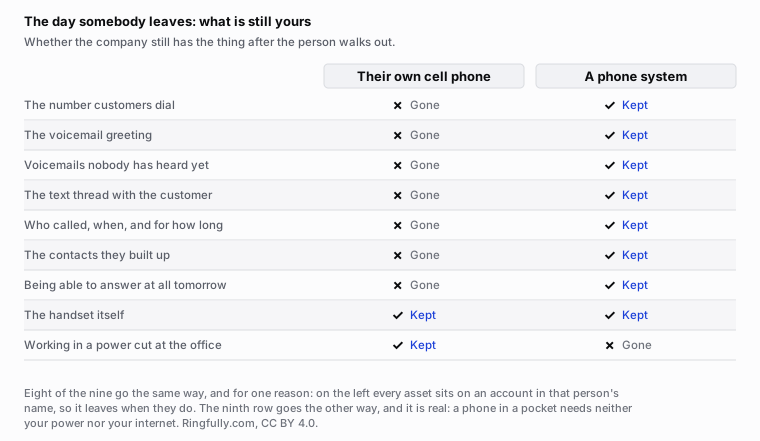
Eight of the nine go the same way, for one reason: on the left every asset sits on an account in somebody else's name.
Reuse this figure anywhere, including commercially, with credit to Ringfully and a link back to this page. CC BY 4.0.
The number is the one people think about, and it is worth being precise about why it is not recoverable.
A phone number moves between providers by being ported, and a port is a request made against the account the number currently sits on. The federal rule that says what a carrier may ask for, 47 CFR 52.36, standard data fields for simple port order processing, lists exactly what is required: the number itself, the account number, the zip code, the company code, the desired due date and a handful of administrative fields, plus an optional passcode where the end user has set one.
Read that as a small business. The account number and the zip code belong to whoever holds the account. If the account is in your employee's name, they are the end user, and the port is theirs to authorize or refuse. There is no clause in there about who has been giving the number out on business cards for six years.
Everything else on the list travels the same way for the same reason. The voicemail greeting is on their handset. The unheard voicemails are on their handset. The text thread with the customer who is mid-job is on their handset. The call history that would tell you who has been calling and how often is on their carrier's bill, addressed to them.
What a phone system changes, in plain terms
The company holds one published number. Calls to it are delivered to whichever phones you say, including the cell phones people already carry. When somebody leaves, you remove them, and the number, the greeting, the messages and the history are exactly where they were the day before. The machinery underneath that is an ordinary cloud phone service, described in what VoIP is and how it works.
Three other things follow, and they are the ones people notice first:
- More than one person can be offered the same call. The front desk and the workshop, or whoever is not already busy. One number with sales, service and billing behind it is the shape most small teams end up with.
- Voicemail lands somewhere the business can see. Where a message actually goes matters more than it sounds, because the usual failure is not a lost message, it is a message in a box nobody owns.
- The person's own number stays private. They answer work calls on their own handset without giving it out, and outbound calls show the business number.
The arrangement most small teams actually land on
Not desk phones for everybody. Not a rule that people carry two devices. The workable shape is:
- The company owns the number, the greeting and the voicemail box.
- Calls are delivered to whatever people carry, which is usually their own phone with a work app on it, and a handset at the desks where somebody actually sits.
- A rule decides who is offered the call, so a customer reaches somebody free rather than somebody specific.
- Personal numbers stay personal, in both directions.
That is one licence per person who answers the phone, not one per employee, which is the distinction that decides the bill. What that costs is on the pricing page.
What we do not do
We do not supply cell service, cell phones or plans, and we do not manage anybody's carrier account. We have no office anywhere and no on-site technician. Numbers are provisioned by hand rather than bought from a page, and there is no self-serve signup.
More of the groundwork is on the VoIP basics topic page.
Questions people ask
- Can I just use cell phones as my business phone system?
- You can, and plenty of two and three person businesses do it for years. It works while one person answers everything and nothing has to survive that person. It stops working when a customer needs to reach whoever is free rather than whoever they met last, when two people need to see the same text thread, or when somebody leaves and takes the number with them.
- What happens to the business number if an employee leaves?
- If the number is on their personal account, it goes with them, and there is no process that gets it back. A number is transferred from the account it sits on, and the transfer request has to match the account holder's own details, so the person whose name is on the bill decides where that number goes. If the number is on a company account, the person leaves and the number stays.
- Should I let staff use their own phones for work calls?
- It is fine for outbound convenience and poor as the published number. The workable middle is that the company owns the number and the voicemail box, and the call is delivered to whatever phone the person happens to be carrying. They keep their own number private, you keep the customer relationship, and the arrangement survives them changing jobs or changing carriers.
- What does a customer see when staff answer on their own cell phones?
- Their personal number, unless something is deliberately arranged otherwise, so the customer saves it and dials it directly forever after. That is the moment the relationship moves from the business to the individual. It also means calls arrive at one specific person whether or not that person is working today.
- Do I still need desk phones if everyone has a cell phone?
- No. A cloud phone system can deliver a call to a browser tab on a laptop, to a desk handset, to a cell phone, or to several of those at once. Desk phones are worth it where somebody sits in one place all day and wants a handset and a speaker; they are not required, and buying one for every person is the most common way a phone quote gets bigger than it needed to be.
About the author
John
Owner and CEO
Owner and CEO with over 10 years of experience in the IT industry, including more than 5 years specializing in VoIP and cloud communications. Experienced in designing, deploying, and supporting reliable communication solutions for businesses.

Keep reading
If you are working out whether VoIP suits your team, tell us how many people answer the phone and what your connection is like, and we will say plainly whether it fits.