Blog
VoIP vs landline for a business
What a landline still does better, what a cloud phone system does better, and the four questions that decide which one your business should run on.
John · Owner and CEO · 6 min read ·
A landline is powered from the line and terminates at one address. A cloud phone system is neither, which is why it can ring three people in two places and why it goes quiet when your power does. Most small businesses are better on the second. The case for the first is real, and it is short.
Almost every comparison of the two is written by somebody selling one of them, which is why they all read like a clean sweep. It is not a clean sweep. Below are the rows that genuinely go each way, and the four questions that decide it for a particular business.
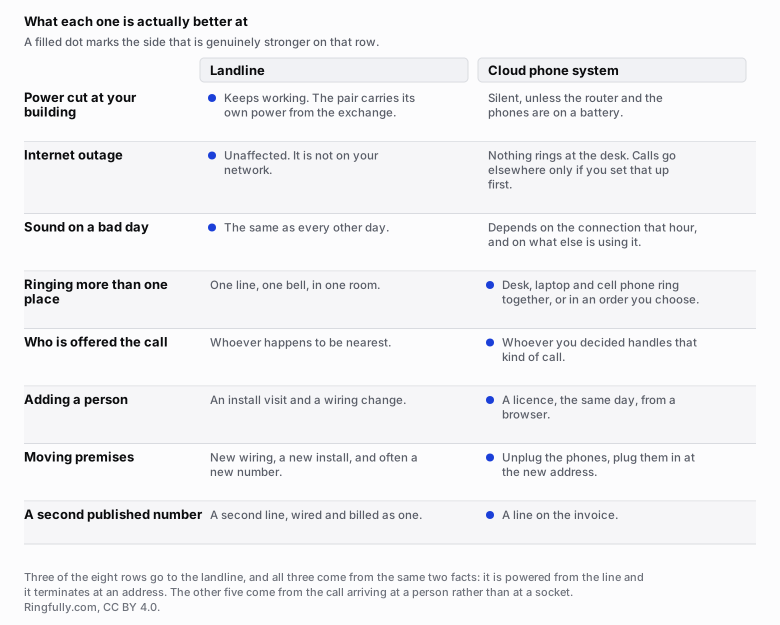
Three of the eight rows go to the landline, and all three come from the same two facts about it.
Reuse this figure anywhere, including commercially, with credit to Ringfully and a link back to this page. CC BY 4.0.
The two facts that decide everything
A traditional copper line carries its own electricity. The pair coming into your building is powered from the phone company's end, so a plain corded handset works during a blackout with nothing plugged into a wall socket. That is not a feature somebody added. It is how the thing was built, and no cloud service can copy it, because a cloud call needs a router, a switch and a phone, and all three need power from your building.
A copper line also terminates at an address. One pair, one socket, one bell. That is a limitation for almost everything a growing business wants to do, and it is the reason the line is dependable: nothing about it changes because somebody in the next room started a backup.
Everything else on both sides follows from those two facts. If the cloud side of the comparison is the unfamiliar one, what VoIP is and how it works sets out what replaced the line, the switch and the carrier, and why the power question falls out of that.
Where the landline still wins
A power cut. Corded handset, copper pair, dial tone. This is worth checking rather than assuming, because a lot of what people call a landline today is not one. If your phone service arrives through the same box as your internet, from a cable or fiber company, it is not copper and it stops when the box does.
An internet outage. Your connection can fail on its own without the power going anywhere, and a copper line does not notice. A cloud phone system notices immediately.
Consistency. A landline sounds the same every day. A cloud call is as good as the room left on your connection at that moment, which is why how much bandwidth a call actually needs is worth working out before anyone tells you it will be fine.
Two of those three are about staying up when something else has failed, and they are the reason a lot of businesses keep exactly one copper line: the alarm panel, the elevator phone, or a handset in the back that nobody uses until the day they need it.
What the federal rules say about the power question
The regulator treats this as the defining difference, and wrote a rule about it. Under 47 CFR 9.20, backup power obligations, a provider of fixed residential voice service that is not line powered has to offer subscribers the option to buy backup power at the point of sale: at least one option giving eight hours of standby power, and, since 13 February 2019, at least one giving twenty-four. The rule says the backup has to cover every piece of the provider's equipment on the premises that has to stay powered for the service to reach 911.
Read what that rule takes for granted. It exists only because the service is not line powered, and it applies to residential service, not to yours. Nobody is required to hand a business a battery. If you want your phones to survive a blackout on a cloud system, that is a small uninterruptible power supply under the desk that holds up the router, the switch and one phone, bought by you, sized by you, and tested once a year by unplugging it.
Where the cloud system wins, and why it is not close
One call can be offered to more than one person. A landline rings a bell in a room. A cloud system can ring the front desk and a workshop and somebody's cell phone at once, or in an order, or only the people who handle that kind of call. This is the whole difference between a phone that makes noise and a phone that reaches somebody.
A second number costs a line on the invoice, not a second install.
Adding a person takes an afternoon, not a visit.
Moving is unplugging. A landline move means new wiring, a new install date and, if you cross a boundary, often a new number. A cloud move means putting the phones in a box and plugging them in at the other end.
You can change what callers hear yourself. Hours, holidays, the menu, the greeting. On most landline setups that is a call to whoever installed the box.
The four questions that actually decide it
- Does more than one person need to be able to answer the main number? If yes, the landline is already the wrong tool, and no amount of reliability makes up for a call reaching a room nobody is in.
- How bad is a two-hour outage? For a clinic taking bookings, annoying. For a locksmith or an emergency plumber, it is the business. That answer decides whether you keep a copper line, buy a battery, arrange a forward, or all three.
- Is your internet good enough, and do you know or are you guessing? A connection that streams fine can still be a poor place to put calls.
- Are you moving or growing in the next three years? Every landline advantage is about staying still, and every cloud advantage is about not having to.
The honest answer for most small businesses
Run the phone system in the cloud and buy back the two things you gave up. A battery under the desk covers the short blackout. A forward configured at the provider, in advance, covers the connection failing. One copper line, if you have a reason for one, covers the rest.
That is a more honest arrangement than either side's marketing, and it is cheaper than most people expect. What it costs depends on how many people need a licence rather than on how many people work there, which is the part that catches people out and is worked through in the true cost of a business phone system.
What we do not do
We do not sell copper lines, we cannot install one, and we have no office anywhere to send somebody from. Numbers are provisioned by hand rather than bought from a page. There is no self-serve signup here: setup is done with you.
More on the basics is on the VoIP basics topic page. What a seat costs is on the pricing page.
Questions people ask
- Is VoIP better than a landline for a small business?
- For most small businesses, yes, but not on every measure. A cloud phone system rings more than one person, follows a rule you wrote about who should answer, adds a person the same day and moves buildings without a wiring job. A landline beats it on two things that matter more than they sound: it keeps working in a power cut, and it keeps working when your internet is down. Decide which of those three or four properties you actually need before you decide the technology.
- Does a landline work when the power is out?
- A traditional copper line does, because the power that runs it comes down the pair from the phone company rather than from a socket in your building, and a simple corded handset needs nothing else. A cordless handset with a base station does not, because the base needs mains power. A cable or fiber phone service is not a copper line no matter what it is called on the bill, and it stops with the box it is plugged into.
- What happens to my phones if the internet goes down?
- The desk phones stop, and calls to your number go wherever your provider was told to send them if the desk does not answer. That instruction has to exist before the outage, because during one you cannot reach anything to set it. The usual arrangement is a forward to a cell phone, configured once at the provider, plus voicemail behind it.
- Can I keep my number if I move from a landline to VoIP?
- Almost always, by transferring it rather than by switching it off. The number is ported from the account it currently sits on, so the account name, the service address and the account number on the bill all have to match what the losing carrier holds. Order the transfer before you cancel anything: cancelling first releases the number and there is no reliable way to get it back.
- Is call quality worse on VoIP than on a landline?
- It is more variable. A landline sounds the same on a busy Monday as on a quiet Sunday because it does not share anything with the rest of your office. A cloud call shares your connection with every download, backup and video meeting in the building, so quality depends on how much room is left and how steady the connection is that hour. Sized and left alone, it is not noticeably different. Squeezed, it is obviously worse.
About the author
John
Owner and CEO
Owner and CEO with over 10 years of experience in the IT industry, including more than 5 years specializing in VoIP and cloud communications. Experienced in designing, deploying, and supporting reliable communication solutions for businesses.

Keep reading
If you are working out whether VoIP suits your team, tell us how many people answer the phone and what your connection is like, and we will say plainly whether it fits.