Blog
What is VoIP phone service?
The service is what you rent monthly, separate from the device and the protocol. What the provider does for the money, and what the bill actually covers.
John · Owner and CEO · 5 min read ·
VoIP phone service is the subscription, as opposed to the device or the protocol. A provider holds your numbers, runs the switching that decides where each call goes, and hands calls to and from the rest of the telephone network. You rent that monthly. The handset, if you have one, you buy once.
Confusing the three is why quotes are hard to compare, so this article is about the middle one. If the underlying mechanics are what you wanted, what VoIP is and how it works covers the transport and this one covers the subscription.
What the provider is actually doing
Four jobs, and it is worth knowing which is which, because providers differ far more on the third and fourth than on the first two.
Holding your numbers. Somebody has to be the carrier of record for each number you use. That is a regulatory relationship, not a database row, and it is what makes porting a scheduled process rather than a click.
Reaching everybody else. Your call has to get to people on copper lines, on cell phones and on other providers. The Federal Communications Commission's term for a service that can both place and receive calls with the ordinary telephone network is interconnected VoIP, and it is defined alongside the counts in the FCC's Voice Telephone Services report. A service that cannot do this is not a phone service, whatever else it does well.
Deciding where a call goes. The switching. Hours, holidays, the menu a caller hears, who rings first and what happens when nobody answers. This is the part that used to be a box in your back room and is now a screen you can open.
Recording what happened. Who called, when, how long, what was said if you record. Undramatic until you need it, and then the only thing that matters.
What you are buying, line by line
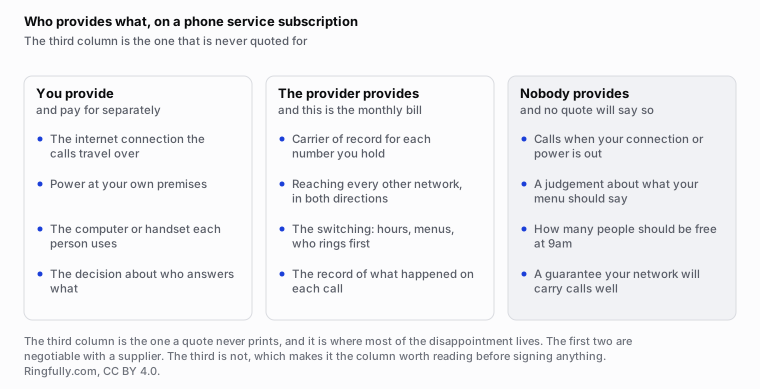
The split that a quote rarely draws. The right-hand column is where most disappointments live.
Reuse this figure anywhere, including commercially, with credit to Ringfully and a link back to this page. CC BY 4.0.
Most bills have the same four parts under different names.
| Line | What it is | What to watch |
|---|---|---|
| Seats | A monthly charge for each person who can make and take calls | Whether it is per person or per simultaneous call. They are different counts and the second is usually cheaper. |
| Numbers | A monthly charge per number you hold | Toll-free numbers cost more and are metered differently. |
| Calling | Minutes beyond whatever the plan includes | Whether the published rate is per minute or per call, and what happens when you pass the allowance. |
| Taxes and fees | Sales tax plus telecom-specific charges | These are real and they are not small. A quote that omits them is not a quote. |
Toll-free is the line people most often misread. Toll-free numbers in North America are allocated through Somos, the central administrator for the 800, 833, 844, 855, 866, 877 and 888 prefixes, and the whole point of one is that the business pays for the minutes rather than the caller. Free to dial means paid by you.
For the full exercise of adding a quote up over three years, including the one-time charges that never appear in the monthly comparison, the true cost of a business phone system does it with two worked examples.
What is not included, in anybody's service
Being clear about this saves an argument later.
Your internet connection. The provider carries the call across the internet. Getting to the internet is between you and whoever sells you that. When calls sound bad, the phone service is often blameless and can rarely prove it.
Your electricity. No VoIP service works in a blackout at your end. What a service can do is decide where calls go when your office is unreachable, which is a setting rather than a rescue.
The decision about who answers. Every provider will give you a menu builder. None of them will tell you what your menu should say, or how many people should be on the phone at your busiest hour. That is a staffing question with an arithmetic answer, and it is the one that decides whether customers reach anybody.
Hardware, usually. Some providers bundle handsets into the monthly price. That is a finance arrangement, not a discount, and the contract length is where it is paid for.
How to compare two of them
Five questions, in order of how much money they move:
- Is the seat a person or a simultaneous call? For a business where six people share the phone but only two are ever on it, this is a threefold difference in the bill.
- What is included, and what is the published rate past it? An allowance with no published overage rate is not an allowance.
- Is there a ceiling on what the account can spend? Ask what happens if somebody gets into your account on a Friday night.
- What is the commitment, and what is owed if you leave? A cheap monthly rate on a three year term is a three year price.
- Who does the setup, and is it billed? Migration and onboarding fees are the single most common surprise line.
Our own answers, for the record: our pricing is per seat with the calling included, published rates past the allowance, a spend ceiling on every plan, no minimum number of seats, and no hardware. Numbers are provisioned by hand rather than bought from a self-serve screen, which means setup involves a conversation with us and is not instant.
If the vocabulary in this article is what tripped you up rather than the money, VoIP meaning, in plain English decodes it, and the rest of VoIP basics covers how the calls get there.
Questions people ask
- What is VoIP phone service?
- It is a subscription to a company that holds your phone numbers, runs the switching that decides where each call goes, and hands your calls to and from the rest of the telephone network. The device on your desk and the protocol underneath are separate things. The service is the part you pay for every month and the part you can change providers on.
- What does a VoIP phone service bill usually include?
- Four things in most cases. A monthly charge per person who can make and take calls, a monthly charge per phone number you hold, calling that goes beyond whatever allowance the plan carries, and taxes and regulatory fees. Add-ons sit on top: extra recording storage, integrations, a second number for a department.
- What is the difference between VoIP service and a VoIP phone?
- A VoIP phone is a piece of hardware you own. VoIP service is the subscription that makes it useful. A handset with no service is a paperweight, and service with no handset still works through a computer. That is why they are priced separately and why a quote that merges them is hard to compare.
- Does VoIP phone service include a phone number?
- Usually one per account, with more available for a monthly charge each. Ordinary geographic numbers and toll-free numbers are priced differently, because toll-free numbers are administered centrally by Somos and the person receiving the call pays for the minutes rather than the caller.
- Can I keep my existing number when I change VoIP provider?
- Yes. Porting moves a number from the carrier that holds it to the new one, and to your callers nothing changes. It is a paperwork process on a schedule rather than a technical one, and it is rejected when the details on the request do not match the losing carrier's records exactly. Never cancel the old service before the port completes.
- What is a spend ceiling and why does it matter?
- It is a monthly limit on what your account can spend on outgoing calls before they stop. It matters because the one genuinely alarming failure on any phone service is somebody else using your account to place expensive calls overnight. A ceiling turns an unbounded bill into a known one.
About the author
John
Owner and CEO
Owner and CEO with over 10 years of experience in the IT industry, including more than 5 years specializing in VoIP and cloud communications. Experienced in designing, deploying, and supporting reliable communication solutions for businesses.

Keep reading
If you are working out whether VoIP suits your team, tell us how many people answer the phone and what your connection is like, and we will say plainly whether it fits.