Blog
VoIP meaning, in plain English
VoIP stands for Voice over Internet Protocol. What each of those four words is doing, what counts as VoIP, and the other names the same thing goes by.
John · Owner and CEO · 4 min read ·
VoIP stands for Voice over Internet Protocol. It means a phone call carried as ordinary internet data rather than over a wire reserved for that call. Say it as one syllable, voyp. Everything a caller experiences stays the same: a number, a ring, a person. What changed is underneath.
What each of the four words is doing
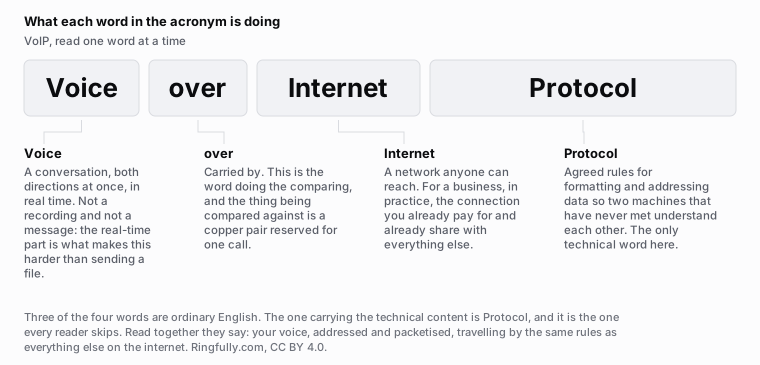
Each of the four words is doing a job. The one that carries the meaning is Protocol, and it is the one nobody reads.
Reuse this figure anywhere, including commercially, with credit to Ringfully and a link back to this page. CC BY 4.0.
Voice. The sound of a conversation, in both directions, at the same time. Not a recording, not a message. The real-time part is what makes this harder than sending a file.
Over. Carried by. This is the word doing the comparison: the alternative is voice over a dedicated circuit, which is what a copper telephone line was.
Internet. A network of networks that anyone can reach. In practice, for a business, the connection you already pay for.
Protocol. An agreed set of rules for formatting and addressing data so that two machines that have never met can understand each other. Internet Protocol, capital I capital P, is a specific one: the addressing layer that every packet on the internet uses.
Put together: your voice, chopped into addressed packets, travelling by the same rules as everything else on the internet.
What counts as VoIP
The useful line is the one the regulator draws. The Federal Communications Commission's category is interconnected VoIP, and its test is whether the service can both place calls to and receive calls from the ordinary telephone network. That definition sits alongside the counts in the FCC's Voice Telephone Services report, and it is the line worth having in your head.
By that test:
- A business phone service with a real phone number that anybody can dial: interconnected VoIP.
- A phone number that rings on a desk phone, on a computer, or both: still interconnected VoIP. Where it rings is not part of the definition.
- A meeting tool where you click a colleague's name and talk: technically the same method, but it reaches nobody outside its own service, so it is not what people mean by the word.
That last case is why the acronym confuses people. VoIP describes a technique, and the technique is used by things that behave very differently.
The other names for the same thing
You will meet these in quotes and on comparison sites, all pointing at overlapping territory.
| The word | What it actually names |
|---|---|
| IP telephony | The same idea, phrased for people who buy telephone systems. Effectively a synonym. |
| SIP | One protocol for setting calls up and tearing them down, defined in RFC 3261. It is the setup conversation, not the audio. |
| SIP trunk | A replacement for the bundle of lines that used to run into an on-site switch. Sold to businesses that still have their own switch. |
| Hosted PBX | Somebody else runs the switching. PBX is the old name for the box in your back room. |
| Cloud phone system | Hosted PBX, sold with newer words. |
| Softphone | The phone as software, on a computer, rather than a device on a desk. |
None of these are wrong. They are just different sizes. SIP is a protocol, a softphone is a device, hosted PBX is a deployment model, and VoIP is the family all of them belong to. Types of VoIP phone systems sorts the deployment models out properly.
Why the acronym is a bad name
It names the plumbing. Nobody chooses a phone system because of the addressing scheme its packets use, and nobody ever complained that their calls were being carried by the wrong protocol.
What people actually care about is whether calls reach the right person, what happens when nobody is free, and what it costs. Those are decisions about how the phone is set up, and they are the same decisions on any transport. The acronym tells you almost nothing about them.
So if you are shopping and someone leads with the technology, that is a signal. The interesting questions are further along: what a VoIP phone service actually includes, what a business phone system really costs once every line of the quote is added up in the true cost of a business phone system, and how many people you need answering to stop calls going to voicemail.
If you want the whole picture rather than the vocabulary, start at what VoIP is and how it works, or browse the rest of VoIP basics. If you already know all this and just want a number, our pricing is per seat with the minutes included.
Questions people ask
- What does VoIP stand for?
- Voice over Internet Protocol. Voice is the sound of a conversation. Internet Protocol is the addressing scheme that gets data across a network. Over means the voice is being carried by that scheme rather than by a dedicated circuit. It is pronounced voyp, one syllable, and some people spell out the letters instead.
- Is VoIP the same as a cloud phone system?
- Not quite. VoIP is the method of carrying the call. A cloud phone system is a product built on that method, where the switching that used to sit in a box in your back room runs in somebody else's data centre instead. Every cloud phone system uses VoIP. Not every VoIP setup is a cloud phone system.
- Is VoIP the same as SIP?
- No. SIP is one protocol used to set calls up and tear them down, defined in RFC 3261. VoIP is the broader idea of carrying voice as data. SIP is the most common way to do the setting up, so the two words get used interchangeably in sales conversations, but they are not the same size.
- Does a video call count as VoIP?
- The voice half of it does, and it works the same way. In everyday use VoIP usually means calls that reach ordinary phone numbers, while a meeting tool that only connects its own users is described differently even though the underlying method is identical.
- Why is it called a phone call if there is no phone line?
- Because from the caller's side nothing else changed. There is still a number, still a ring, still someone answering. The name describes the experience rather than the wiring, which is exactly why the wiring can change without anyone noticing.
About the author
John
Owner and CEO
Owner and CEO with over 10 years of experience in the IT industry, including more than 5 years specializing in VoIP and cloud communications. Experienced in designing, deploying, and supporting reliable communication solutions for businesses.

Keep reading
If you are working out whether VoIP suits your team, tell us how many people answer the phone and what your connection is like, and we will say plainly whether it fits.