Blog
What is a virtual phone number?
A virtual phone number is an ordinary number with no line behind it, only a routing record. What that changes, what it does not, and what to check first.
John · Owner and CEO · 5 min read ·
A virtual phone number is a real telephone number with no physical line behind it. Nothing is wired to a building. The number is a record in a provider's system saying where calls to it should go, and that record can point at a browser, a desk phone, a computer, or a cell phone you already own.
What "virtual" actually means
The number itself is unremarkable. Numbers in the United States and Canada come out of the same plan: ten digits, arranged NXX-NXX-XXXX where N is any digit 2 to 9 and X is any digit 0 to 9. A carrier receives a block of them and assigns one to a subscriber. A virtual number goes through exactly that process.
What differs is the binding at the far end. A traditional line is fastened to a physical circuit terminating in one building. A cell number is fastened to a SIM card in one handset. A virtual number is fastened to an entry in software, and an entry can name several destinations, change at 5pm, and be edited by you in the afternoon. What that arrangement looks like for a company rather than for one person is worked through in a virtual phone number for a business.
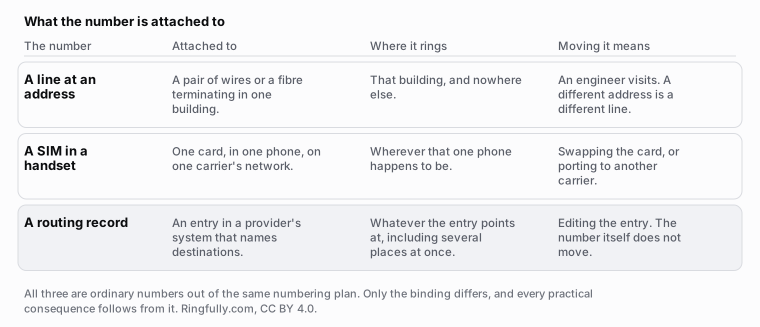
All three rows are ordinary numbers from the same numbering plan. Only what the number is fastened to changes.
Reuse this figure anywhere, including commercially, with credit to Ringfully and a link back to this page. CC BY 4.0.
This is no longer a niche arrangement. In its most recent count, as of 30 June 2025, the FCC reported 63 million interconnected VoIP connections in the United States against 15 million traditional switched access lines. The unusual thing to have now is the copper.
What a virtual number is not
It is not a fake number. It rings, it can be dialled back, and it appears on a bill like any other.
It is not proof of anything. A number can be perfectly formed and reach nobody at all: a valid number is not an active line, and that is true of virtual numbers exactly as it is of every other kind.
It is not an address. The area code is a numbering territory, not a location, and certainly not a business presence.
It is not a phone system. The number is one line in the arrangement. What happens after somebody dials it, who rings first, what a caller hears when nobody is free, whether a message reaches a person, is a separate set of decisions and the part that actually costs money.
It is not free, whatever the offer says. Numbers advertised at no cost are paid for in some other currency, usually ownership or the ability to leave, which is the subject of free virtual phone numbers and the catch.
What you can do with one that you cannot do with a line
- Ring several places at once, or in an order you choose. One published number, three people, and no re-training when the third person leaves.
- Answer differently by time of day. Your hours decide what a caller hears before any phone rings.
- Keep your own cell number private. Customers dial the business number and never see the personal one, which matters most on the day somebody leaves.
- Split one number between different jobs. Sales, service and billing can be different people behind the same number without publishing three numbers nobody remembers.
- Add another number without adding a line. A separate number for a second location, a campaign or one person is a new record rather than an install: how to get a second business number covers the arrangements that hold up.
- Change it yourself. Editing a record is not an engineer visit.
What it cannot do
It does not improve your connection. Calls made this way ride your internet link, and a link with too little headroom sounds bad no matter whose number it is. Work out what the calls actually need before blaming the provider.
It does not make you local. A 617 number does not put you in Boston.
A toll-free number is the same kind of record with a different prefix and a different payer. What a toll-free number means explains who is billed for the minutes, toll-free against a local number is the choice most small businesses actually face, and how to get a toll-free number is the process once that choice is made.
It does not tell a 911 operator where you are. A routing record is not a street address, which is why our emergency calling page says plainly that a call reaches a national centre and an operator has to ask. Keep another way to reach emergency services in the building.
It does not answer itself. If nobody picks up, a virtual number produces a missed call just as efficiently as a copper one.
Four things to check before you take one
- Whose name is the number in? If you are the subscriber of record, the number is yours. If you hold a login, you hold a login.
- Can you port it out, and has anyone done it? Ask the question before you need the answer. Moving a number has its own paperwork, and the time to find out that a number is not portable is not the week you are leaving.
- What happens when nobody answers? Voicemail nobody checks is the same as no answer at all.
- What does it cost when the calls double? Per person, per minute past the allowance, and whether there is a ceiling on the bill.
More on how numbers are issued, what an area code really tells a customer, and what moving one involves: numbers and porting.
How you actually get one from us
There is no self-serve number purchase here. We provision numbers by hand, which means somebody checks the area code you want, tells you what is genuinely available, and sets the routing up with you before anything goes live. It is slower than a checkout page and it is the reason nobody ends up with a number pointed at nothing.
Tell us which area code you want and what the calls have to do once they arrive, and we will say what is possible before you commit to anything.
Questions people ask
- What is a virtual phone number?
- It is a normal telephone number that is not wired to a building. Instead of terminating on a pair of copper wires or a SIM card, it terminates on a record in a provider's system that says where calls to it should go. That record can name a browser tab, a desk phone, a computer, a cell phone you already own, or several of them at once.
- Is a virtual phone number a real phone number?
- Yes. It comes out of the same North American Numbering Plan as every other number, it is allocated to a carrier in a block, and it is assigned to a subscriber the same way. Anyone can dial it from any phone. The only thing that is different is what it is attached to at the far end.
- Can I keep a virtual number if I change providers?
- Usually, but the answer depends on whose name the number is in rather than on the technology. Portability attaches to the subscriber of a number. If you are named on an account with a carrier or a provider, the number moves with you under ordinary porting rules. If you only hold a login to an app that issued you a number, read the terms before you print it on anything.
- Does a virtual number with a local area code make my business local?
- No. An area code says which numbering territory a number was issued in. It says nothing about where you are, whether you have premises there, or whether you are registered to trade in that state or province. A local number is a signal a caller reads, and it is only worth sending if the service behind it is genuinely available in that area.
- What does a virtual number cost?
- The number itself is a small monthly line item almost everywhere. The cost that matters is what sits behind it: the per-person charge for the software people answer on, and the per-minute rate once an included allowance runs out. Compare those two, not the price of the number.
About the author
John
Owner and CEO
Owner and CEO with over 10 years of experience in the IT industry, including more than 5 years specializing in VoIP and cloud communications. Experienced in designing, deploying, and supporting reliable communication solutions for businesses.

Keep reading
A free tool for this, in your browser: the phone list cleaner.
If you are moving a number, or getting a new one, tell us which and where, and we will walk you through what happens to your calls on the day.