Blog
How to get a second business number
Four routes to a second number: a carrier line, an app, a business provider, or forwarding. What each one costs you in control, and how to choose between them.
John · Owner and CEO · 4 min read ·
There are four ways to end up with a second business number: a line from your existing carrier, a number inside a consumer app, a number from a business phone provider, or forwarding the one you already have. They differ less in price than in who owns the number afterwards.
The four routes, side by side
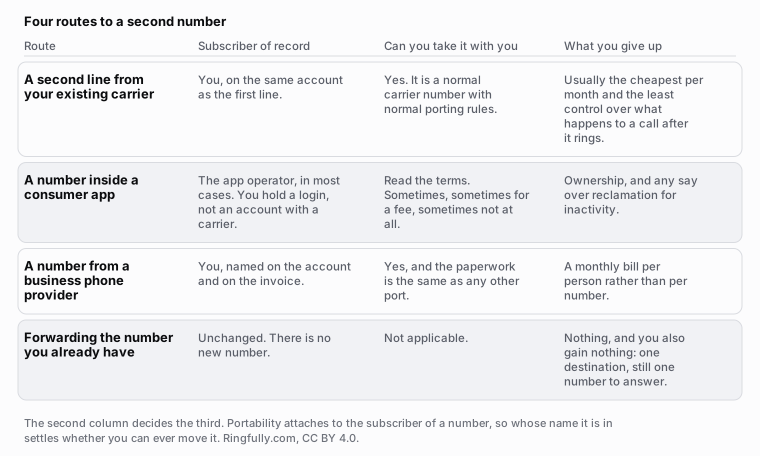
The second column decides the third, and it is the column nobody compares.
Reuse this figure anywhere, including commercially, with credit to Ringfully and a link back to this page. CC BY 4.0.
A second line from your existing carrier
The path of least resistance. You already have an account, they already have your details, and the number is a normal carrier number with normal rules attached to it.
What you get is a number. What you do not get is much say over what happens to a call after it rings: the ringing order, the hours, what a caller hears while nobody is free. On a mobile account it usually means a second SIM and therefore a second handset, which is a real cost people forget to count.
A number inside a consumer app
Fast, cheap or free, and genuinely useful for the right job.
The trade is ownership. On most of these you hold a login rather than an account with a carrier, which decides whether you can ever take the number elsewhere and whether it can be reclaimed if you go quiet for a season. That is not a hidden trap, it is written in the terms, but almost nobody reads the terms before printing a number on a vehicle. What a free number actually costs you goes through the four clauses worth finding.
A number from a business phone provider
The number arrives attached to the software people answer on, which is the actual purchase. It is a virtual phone number in the ordinary sense, a routing record rather than a line into a building. You are named on the account and on the invoice, so porting later is ordinary paperwork.
The cost model is different and worth understanding before you compare prices: you are usually billed per person per month rather than per number, so a second number for the same two people costs almost nothing extra, while a third person costs a seat.
Forwarding the number you already have
Worth naming because people do it without thinking of it as a route, and because it is often the right answer.
Forwarding adds a destination. It does not add a number, it does not separate anything, and the call still lands on one phone at a time. If your problem is "the calls all come to me", forwarding moves the problem rather than solving it. If your problem is "I am not at the shop on Fridays", forwarding solves it entirely and costs nothing.
The question that decides all four
Not "how much per month". Whose name is the number in?
Under the FCC's rules, number portability is the ability of users to retain existing numbers when switching from one carrier to another. Read that carefully: it is a right that attaches to the user of a number with a carrier. If nobody holds a carrier account in your name, there is nothing for the right to attach to, and whether you can move the number becomes a commercial favour rather than a rule.
So the same question, asked before you commit, tells you three things at once: whether the number is yours, whether you can leave, and how much your provider has to care about keeping you.
Before you commit
- Ask for the porting procedure in writing. Not "can I port it". The steps and the fee.
- Decide the area code deliberately. It is a signal, and signals are read. A number outside your area is fine if you can actually serve the callers it attracts.
- Decide what happens when nobody answers, before the number exists. A number that rings out is worse than no second number, because it looks staffed.
- Check the number is live before you print it. A number can be perfectly formed and reach nobody. Dial it from a phone that is not yours.
- Plan for both numbers to ring for two years. People do not update their contacts. Publish the new one everywhere and keep the old one working.
If the second number exists because different kinds of call need different people, read one number, sales, service and billing first. A second published number is often the more expensive answer to that problem, and the calls that go to the number nobody watches are the ones you never hear about.
The wider ground, area codes, allocation and moving numbers between providers, is in numbers and porting.
How you get one from us
By asking a person. There is no page where you pick a number and pay for it: we provision numbers by hand, so somebody checks what is actually available in the area code you want, tells you honestly if it is not, and builds the routing with you before the number goes anywhere public.
That is slower than a checkout and it is deliberate. Tell us what the second number is for and we will tell you which of the four routes above is actually right, including the ones that are not us.
Questions people ask
- How do I get a second phone number for my business?
- Four routes. Ask your existing carrier for a second line. Take a number inside a consumer second-number app. Buy one from a business phone provider, where it comes with the software people answer on. Or forward the number you already have, which adds a destination without adding a number. They differ far less in monthly price than in who is named as the subscriber afterwards.
- Do I need a second phone or SIM for a second business number?
- No, and this is the part that has genuinely changed. A number that terminates in software rings whatever you sign in on: a browser tab, a computer, a desk phone, a cell phone you already own. A second physical handset is now a choice about how you like to work, not a requirement of having a second number.
- Which route is best for a small business?
- If the number will go on signage, invoices and listings, take the route where you are named as the subscriber and porting is documented, which usually means a carrier line or a business provider. If the number is disposable, a campaign, a test market, a side project, an app number is fine and cheap. Match the permanence of the route to the permanence of the number.
- Can I keep my personal number and add a business one?
- Yes, and it is the usual arrangement. The business number is published everywhere and rings whoever is meant to answer, while the personal number keeps working for the people who already have it. Expect the old number to keep ringing for a year or two, and make outbound business calls show the business number so people save the right one.
- What should I check before committing to a second number?
- Whose name the number is in, whether it can be ported out and by what documented process, what happens to a call when nobody answers, and what the arrangement costs when call volume doubles. The first of those four silently answers the second, which is why price comparisons alone tell you very little.
About the author
John
Owner and CEO
Owner and CEO with over 10 years of experience in the IT industry, including more than 5 years specializing in VoIP and cloud communications. Experienced in designing, deploying, and supporting reliable communication solutions for businesses.

Keep reading
A free tool for this, in your browser: the phone list cleaner.
If you are moving a number, or getting a new one, tell us which and where, and we will walk you through what happens to your calls on the day.