Blog
Toll-free or local: which number to use
One signals national reach, the other signals proximity. Which a customer trusts depends on what they are buying, and on what the number sets them up to expect.
John · Owner and CEO · 4 min read ·
A toll-free number signals reach. A local number signals proximity. For a business whose customers are choosing somebody nearby, the local number usually wins, because proximity is what they are filtering for. For a business selling across the country, the toll-free number removes a doubt.
What each number tells a stranger
Nobody reads a phone number neutrally. They read it in about a second, on a listing beside four competitors, and they act on what they read.
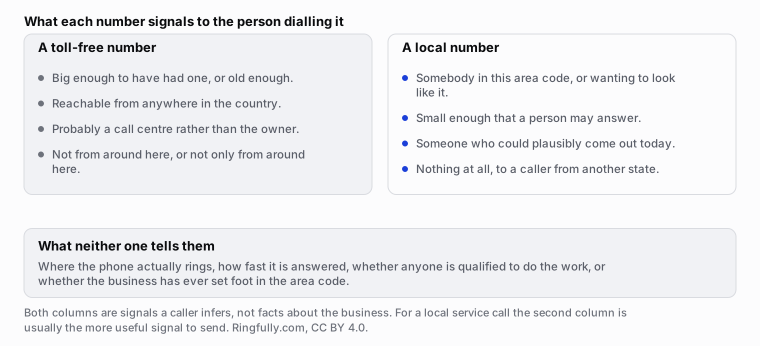
Both columns are inferences, not facts. The third band is what the number never says either way.
Reuse this figure anywhere, including commercially, with credit to Ringfully and a link back to this page. CC BY 4.0.
The two signals are not opposites, which is why the comparison is usually framed badly. A toll-free number answers "can I reach them, and will it cost me". A local number answers "are they near me, and will a person pick up". Those are different questions, and your customer only has one of them.
Why local usually wins for local work
Think about what a person is doing when they need a plumber, a clinic appointment or a locksmith. They are not shopping a category. They are trying to establish, quickly, that somebody can come and deal with it.
An area code is a numbering territory in the North American plan, not a location, and portability and overlays have blurred what it implies. It still gets read as "nearby", because for most people most of the time it still is. That reading is doing real work on a listing page: it is the difference between "these people are around the corner" and "this is a call centre somewhere".
A toll-free number sends the other signal, and for this customer the other signal is a mild negative. It suggests scale, a menu, and somebody who will book you in for Thursday.
Where toll-free genuinely wins
Being fair about this matters, because the local-number case is oversold too.
- Selling across the country. If a customer in another state is deciding whether to call a company they have never heard of, an unfamiliar area code is a small friction and toll-free removes it.
- Support lines for existing customers. These callers already know who you are, so the signal is irrelevant and the reach is not.
- A memorable vanity number. A number people can recall from a radio spot has a value a local number cannot match, though getting the one you want is harder than most people expect.
- A business that moves. A toll-free number is tied to no territory. The rules are explicit that a toll-free subscriber's geographic location has no bearing on which toll-free number it can obtain, so a relocation across the country costs you nothing in reprinting.
And the honest counterweight to the local case: a local number in an area you cannot actually serve is worse than no number at all. It buys a call you then have to disappoint, and the review that follows is about the disappointment.
What the published comparisons are worth
You will find pages quoting a specific uplift for local numbers over toll-free ones. Treat them carefully. Nearly all of it comes from companies selling one of the two, the underlying tests are rarely described, and the results are almost never separable from the industry, the ad, and the market they ran in.
The reasoning above stands without a number attached to it: a customer filtering for proximity responds to a proximity signal. That is enough to make a decision on, and it is more honest than borrowing somebody's percentage.
What is measurable is the thing on your own side of the line, which is what happens after the phone rings. What a missed call is actually worth is arithmetic you can do with your own numbers, and it will almost always dwarf the difference between two area codes.
Running both
Plenty of businesses publish both, and it is a reasonable arrangement with one condition: both numbers land in the same place and are answered the same way.
The failure mode is not cost, it is neglect. The second number goes on one directory listing, ends up ringing a handset that moved desks two years ago, and quietly collects the calls you never hear about. If you run two, put both on the same routing, check both quarterly by dialling them from an outside phone, and count them together.
Remember that the toll-free one also charges you per completed call, wrong numbers included: what toll free actually means covers who pays for what.
How to choose in one question
What is the doubt in your customer's head at the moment they look at your number?
If it is "are these people near me", take the local number. If it is "can I reach these people at all, and what will it cost me", take the toll-free one. If it is genuinely both, take both and maintain both.
For the wider ground, area codes, allocation, and moving a number you already have, see numbers and porting.
One thing we will not do is sell you a local presence. We have no office anywhere, and a number we set up for you is a routing record, not a branch, which is precisely what a virtual phone number is. What we will do is tell you which of the two we think fits what you actually sell, including when the answer is the cheaper one: tell us who calls you and why.
Questions people ask
- Is a toll-free number or a local number better for a small business?
- For a business whose customers are choosing somebody nearby, a local number is usually the better signal, because proximity is precisely what those customers are filtering for. For a business selling across the country, a toll-free number removes a doubt a local number leaves in place. The question is not which is better, it is which doubt your customer actually has.
- Does a local number get more calls than a toll-free one?
- For local service work, most owners find it does, and the reasoning is sound: a familiar area code reads as somebody who can turn up. Be careful with the percentages quoted online, though. Almost all of them come from vendors with something to sell and no published method, so treat them as an argument rather than as evidence.
- Should I have both a toll-free and a local number?
- It is common and it can work, but only if both are answered the same way and both appear consistently. The usual failure is a second number that nobody watches: it goes on one listing, gets forgotten, and the calls to it disappear quietly. Two numbers means two things to maintain, and a toll-free number costs you per minute on top.
- Does a toll-free number make a business look bigger?
- It reads as larger, older and national, which is sometimes exactly the impression you want. It also reads as a call centre, a hold time and a menu. If your real advantage is that a person answers in three rings, a toll-free number can work against you before anybody has spoken.
- Can a toll-free number have a local area code?
- No. The two are mutually exclusive by design. Toll-free numbers use the 800, 833, 844, 855, 866, 877 and 888 codes, and the FCC's own rules note that a toll-free subscriber's geographic location has no bearing on which toll-free number it can obtain. If you want the local signal, you need an actual geographic number.
About the author
John
Owner and CEO
Owner and CEO with over 10 years of experience in the IT industry, including more than 5 years specializing in VoIP and cloud communications. Experienced in designing, deploying, and supporting reliable communication solutions for businesses.

Keep reading
A free tool for this, in your browser: the phone list cleaner.
If you are moving a number, or getting a new one, tell us which and where, and we will walk you through what happens to your calls on the day.