Blog
How to get a toll-free number
Toll-free numbers come from one shared North American pool, reserved through a RespOrg. How the process works, and why the number you want is already gone.
John · Owner and CEO · 5 min read ·
You cannot buy a toll-free number from a shop. Every one in North America lives in a single shared database, and only a Responsible Organization can reserve one out of it for you. That is why availability has to be checked on your behalf, and why the vanity number you want is almost certainly taken.
One database for the whole continent
Ordinary numbers are handed out territory by territory: a carrier gets a block inside an area code, and a subscriber gets one from the block. Toll-free numbers work nothing like that. There is one pool, shared across the United States, Canada and the rest of the numbering plan, administered by Somos, the toll-free numbering administrator.
That single pool is what makes a toll-free number genuinely national. It is also what makes a specific one hard to get: everybody in the plan has been drawing from the same pool for decades, and a number only becomes available again when somebody else finishes with it.
The RespOrg, and why you never talk to the registry
The rules define a Responsible Organization as the entity chosen by a toll-free subscriber to manage and administer that subscriber's records in the toll-free database. Your provider is one, or buys from one. Every toll-free number has exactly one at a time.
This is the part people find odd. You are the subscriber, the number is yours, and you still cannot see the database or move your own record in it. Two practical consequences:
- "Is this number available" is a question somebody asks for you. A number that is spare this morning can be gone by the afternoon, because every RespOrg in North America is reading the same pool.
- Changing providers means changing the RespOrg on the record. It is a different mechanism from a geographic port, and the same rule applies: do not cancel anything until the change has completed.
The path a number takes, with the clock running
The database is not a list of owned and unowned numbers. It is a set of states, and the rules cap how long a number may sit in each one.
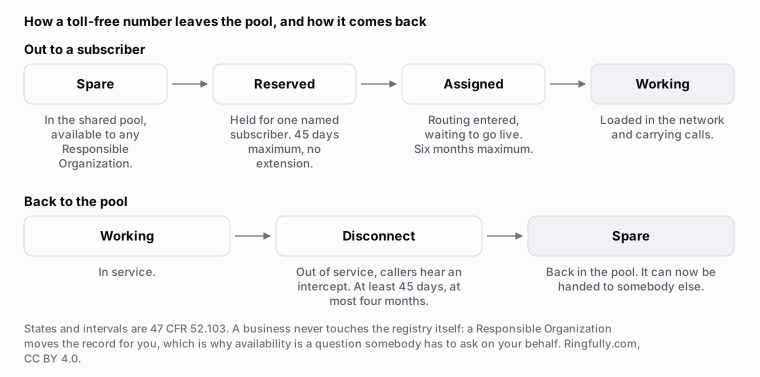
Every state and every interval on this path is written into the FCC's rules, and a Responsible Organization moves the record, not you.
Reuse this figure anywhere, including commercially, with credit to Ringfully and a link back to this page. CC BY 4.0.
The intervals are set out in the rules, and they are firm. A number may stay reserved for a maximum of 45 days, with no extension after the initial period. It may stay assigned, meaning routing is entered but it is not live, until it goes working or for six months, whichever comes first. Coming the other way, a disconnected number must sit in disconnect status for at least 45 days and at most four months before it can be handed to anybody else.
Read the last one again if you are inheriting a toll-free number from a business you bought: for weeks after a number is given up, callers reach an intercept rather than you.
Why the number you want is unavailable
Three reasons, in order of how often they are the real one.
Somebody has it. Most memorable combinations were taken long ago and are still working.
It is not in spare status yet. A number given up last month is sitting out its disconnect period and cannot be reserved by anybody.
Nobody is allowed to be holding a pile of them for you. The rules cap how many numbers a RespOrg may hold in reserve at once, and separately prohibit warehousing, where a RespOrg reserves numbers with no identified subscriber behind them. That is why a provider will not sit on twenty candidates while you decide.
There is a related rule worth knowing before somebody offers you a shortcut. The FCC's hoarding rule prohibits acquiring more toll-free numbers than you intend to use, and defines number brokering, the selling of a toll-free number by a private entity for a fee, as a form of hoarding. Assignment is otherwise on a first-come, first-served basis or by competitive bidding. Treat anyone selling you a specific 800 number as a risk to price in, not a bargain.
What to ask for, in the order that works
- The pattern, not the number. Give your provider two or three digit patterns you would be happy with rather than one number you have set your heart on.
- Any of the seven codes. 800 carries the strongest signal and is the most exhausted. 833, 844, 855, 866, 877 and 888 are toll-free in exactly the same way and read almost identically to a caller.
- A check that it rings before it is printed. A number that exists is not the same as a number that works, and toll-free numbers are the easiest kind to get wrong quietly.
- The per-minute rate and what happens on a bad month. You pay for every completed call to it, including the ones you did not want.
Before committing, it is worth being sure the signal is the one you want to send: what toll free actually means covers who pays and what a caller reads into it. If the idea of a number that is a database record rather than a line is the new part, what a virtual phone number is starts there. If you already have a number elsewhere, moving a number between providers covers what the transfer needs from you. The rest of this ground is in numbers and porting.
How we do it
We are not a Responsible Organization ourselves. A toll-free number we set up for you is reserved through the carrier we buy numbers from, which is one, and there is no page here where you pick a number and pay for it. Somebody checks the pool for the pattern you want, tells you what is genuinely there, and builds the routing before the number goes on anything printed.
Tell us the pattern you want and what the calls have to do, and we will come back with what is actually available rather than what would be nice.
Questions people ask
- How do I get a toll-free number?
- You ask a provider to reserve one for you. Every toll-free number in North America lives in a single shared database administered by Somos, and only a Responsible Organization, a RespOrg, can move a record in it. You never touch the database yourself, which is why availability is something somebody has to check on your behalf rather than something you browse.
- What is a RespOrg?
- The FCC's rules define a Responsible Organization as the entity chosen by a toll-free subscriber to manage and administer that subscriber's records in the toll-free database. In practice it is your carrier or phone provider, or theirs. Each toll-free number has exactly one RespOrg at a time, and changing providers means changing the RespOrg on the record.
- Why can I not get the toll-free number I want?
- Because there is one pool for the whole numbering plan and it has been drawn from for decades. Memorable combinations went first and mostly have not come back. A number only returns to the pool after its subscriber gives it up and it has sat out a mandatory disconnect period, so availability is a matter of what somebody else has recently finished with.
- Can I buy a specific toll-free number from a broker?
- Be careful. The FCC's rules prohibit acquiring more toll-free numbers than you intend to use, and specifically define number brokering, the selling of a toll-free number by a private entity for a fee, as a form of hoarding. Anyone offering to sell you a particular 800 number is operating in territory the regulator has named explicitly.
- How long does it take to get a toll-free number working?
- The reservation itself is quick, but it is not open-ended: a number may sit in reserved status for a maximum of 45 days with no extension, and in assigned status for at most six months before it must be working or given up. So the timer starts when the number is reserved, not when you get round to using it.
- Can I keep a toll-free number if I change providers?
- Yes. Toll-free numbers move by changing the RespOrg of record rather than by a geographic port, but the practical advice is identical: never cancel the old service before the transfer completes, because a released number goes back to the pool and may not be recoverable.
About the author
John
Owner and CEO
Owner and CEO with over 10 years of experience in the IT industry, including more than 5 years specializing in VoIP and cloud communications. Experienced in designing, deploying, and supporting reliable communication solutions for businesses.

Keep reading
A free tool for this, in your browser: the phone list cleaner.
If you are moving a number, or getting a new one, tell us which and where, and we will walk you through what happens to your calls on the day.