Blog
What a toll-free number actually means
Toll free is a statement about the bill, not the digits: the business pays. The 8XX codes, who administers them, and what the phrase is worth now.
John · Owner and CEO · 4 min read ·
Toll free is a statement about the bill, not about the digits. The FCC defines a toll-free number as one where the toll charges for a completed call are paid by the business being called, not by the caller. That is the whole definition, and most of what people believe about 8XX numbers comes from misreading it.
The definition, in the regulator's own words
The rule is one sentence: a toll-free number is a telephone number for which the toll charges for completed calls are paid by the toll free subscriber. The same rule adds something people find surprising, that the subscriber's geographic location has no bearing on what toll-free number it can obtain.
Two consequences fall straight out of that.
A toll-free number is not an area code. It covers no territory and says nothing about where anybody is. 800 is not "the 800 region". Like almost every business number issued today it is a routing record rather than a wire, which is what a virtual phone number means.
The number gets more expensive the better it works. You are billed by the minute for calls that complete, which means a successful campaign, a wrong number, and an automated dialer working through a range all arrive on the same invoice.
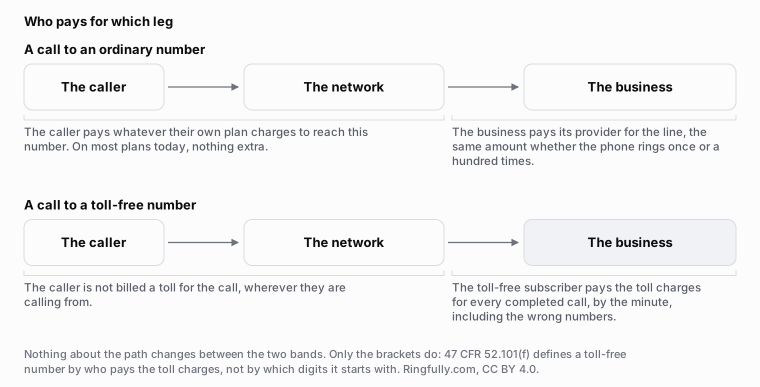
Nothing about the path changes. Only who is billed for which half of it.
Reuse this figure anywhere, including commercially, with credit to Ringfully and a link back to this page. CC BY 4.0.
Which numbers are actually toll free
Seven codes are in service across the United States, Canada and the rest of the North American numbering plan: 800, 833, 844, 855, 866, 877 and 888. They are administered as one shared pool by Somos, the toll-free numbering administrator, rather than being handed out region by region the way ordinary numbers are.
Two things follow. A toll-free number is genuinely national, because there is one pool and no territory. And a specific number you want is very likely already taken, because everyone in the plan has been drawing from that one pool for decades.
Numbers that are not toll free, whatever anyone tells you: anything starting 8 that is not on that list, and the three-digit service codes such as 811 and 988, which are something else entirely.
What "toll free" is worth now
The phrase was built for a world where a caller in another state paid real money per minute to reach you, and removing that charge removed a genuine reason not to call. That world is largely gone. Domestic long distance has been bundled into ordinary plans in the United States and Canada for years, so for most callers on most days, the toll a toll-free number saves them is zero.
What is left is not nothing. It is a signal, and signals still work:
- Reach. It reads as a business that expects calls from everywhere.
- Size. It reads as older, larger, more established. Sometimes that is exactly what you want. For a two-person local trade it usually is not.
- Permanence. It is not tied to a place, so it survives a move across the country intact.
And a signal you may not want: a toll-free number also reads as a call centre, a hold time, and a menu. If your advantage is that a person picks up in three rings, the number can work against you before anyone has spoken.
What it costs you, honestly
Three costs, only one of which is on the price list.
Per minute, on every completed call. Budget it against real call volume, not the number of customers.
The wrong calls. Toll-free ranges are heavily dialed by automated systems, and you pay for the ones that connect. Screening and a menu help; nothing removes it.
A second number to maintain. Most businesses that take a toll-free number keep their local one, which is the right call and doubles the number of places a change has to be made.
If you are weighing the total, what a business phone system actually costs puts the per-minute part next to everything else on the invoice.
Do you need one?
Ask what you want a stranger to assume when they read your number on a listing. If the answer is "they cover the whole country and this is a serious operation", a toll-free number says it in ten digits. If the answer is "they are nearby and somebody local will answer", a local number says that better, and the comparison between the two is worth reading before you choose.
Either way, the mechanics of getting one are not what people expect, because there is no shop: how a toll-free number is reserved covers the registry, the RespOrg and why your first choice of vanity number is gone. The rest of the ground on numbering and moving numbers between providers is in numbers and porting.
We provision numbers by hand rather than selling them from a page, toll-free ones included, and we will tell you when a local number would serve you better. Our pricing is per person per month with minutes included and a ceiling on the bill, so a month of nuisance calls to a toll-free number cannot quietly become the largest invoice of the year.
Questions people ask
- What does toll free mean?
- It means the business being called pays the toll charges rather than the person calling. The FCC's rules define a toll-free number as a telephone number for which the toll charges for completed calls are paid by the toll-free subscriber. It is a billing arrangement, not a different kind of telephone number.
- Which numbers are toll free?
- In the United States and Canada, numbers beginning 800, 833, 844, 855, 866, 877 and 888. They are not area codes, they cover no territory, and they are administered as one shared North American resource by Somos rather than being issued region by region. Anything else claiming to be toll free is not.
- Who pays for a toll-free call?
- The business, by the minute, for every completed call. That includes the wrong numbers, the people who hang up after ten seconds, and the automated calls that dial every number in a range. The caller pays nothing extra, which is the point, and also the reason the arrangement gets more expensive the better it works.
- Is a toll-free number still worth having?
- Less than it was, for a specific reason: the saving it offers the caller is usually zero now that domestic long distance is included in ordinary plans. What survives is the signal. A toll-free number reads as national reach and a certain size, which is worth having if that is what you want to be read as, and worth avoiding if it is not.
- Can a toll-free number be reached from another country?
- Not reliably. A North American toll-free number is reachable from within the numbering plan depending on what the subscriber's provider has arranged, and calls from outside it are frequently blocked or charged. If overseas customers matter to you, publish an ordinary number they can dial as well, and check the reachability with the provider rather than assuming it.
About the author
John
Owner and CEO
Owner and CEO with over 10 years of experience in the IT industry, including more than 5 years specializing in VoIP and cloud communications. Experienced in designing, deploying, and supporting reliable communication solutions for businesses.

Keep reading
A free tool for this, in your browser: the phone list cleaner.
If you are moving a number, or getting a new one, tell us which and where, and we will walk you through what happens to your calls on the day.