Blog
A virtual phone number for a business
Keeping your cell number private, covering an area code you have no office in, and the part of the pitch nobody prints: what a number cannot buy you.
John · Owner and CEO · 4 min read ·
A business virtual number does two things worth paying for: it keeps your own cell number off customer screens, and it lets one published number reach whoever is free. It does not put you in a city, staff your phone, or make anyone answer faster. Those are the honest halves of the pitch.
The personal-number problem
Most small businesses start with somebody's cell number on the van. It works, and it quietly becomes the most expensive decision in the company.
The number is in a thousand phones and on every invoice you have ever sent. It rings at 9pm and on holiday. It cannot be handed to a new hire, because handing it over means handing over the phone. It cannot be answered by anybody else when its owner is up a ladder. And on the day that person leaves, or you sell the business, the number leaves with them and the calls follow it.
A separate business number fixes exactly that and nothing else. It is a number nobody's private life is attached to, which means it can ring three handsets, be answered by whoever is free, and stay with the business when a person does not.
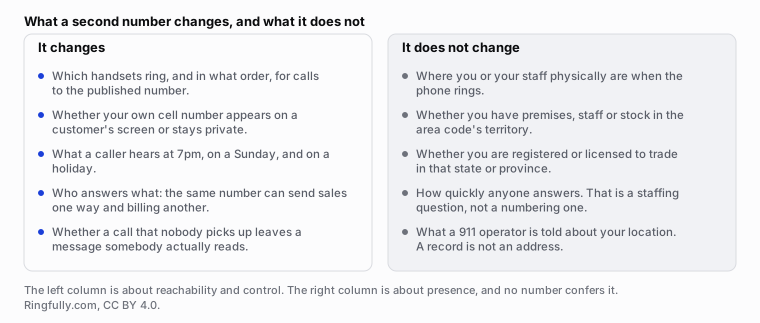
The left column is about reachability and control. The right column is about presence, and no number confers it.
Reuse this figure anywhere, including commercially, with credit to Ringfully and a link back to this page. CC BY 4.0.
This is now the ordinary way to run a business line rather than the clever one. As of 30 June 2025 the FCC counted 63 million interconnected VoIP connections in the United States against 15 million traditional switched access lines.
The area code you have no office in
The pitch is familiar: take a local number in the next city, look like you are there, win work you would not otherwise be called about.
The mechanism is real. An area code is a numbering territory in the North American plan, a number from it is dialable by anyone, and people do read a familiar area code as "nearby". Overlays and fifteen years of number portability have weakened that reading, but it has not gone.
The problem is what happens after the phone rings. A caller who dials a local-looking number expects local answers: you know the neighbourhood, you can be there this afternoon, you work the same hours they do. If the honest answer is "we are four states away and can be with you Thursday", the number bought you a conversation you then have to disappoint.
So the test is not "can I get that area code". It is: if this call goes well, can I actually do the work? If yes, take the number and say plainly on the website where you are based. If no, a number is the most expensive way to buy a bad review.
What the number does not give you
It does not give you premises, staff, stock or a licence to trade in that state or province. It does not change how quickly anybody answers, which is a staffing question and not a numbering one: what a missed call is actually worth is the arithmetic that decides how much answering is worth buying.
And it does not tell an emergency operator where you are. A routing record is not a street address.
We are not neutral about this and we will not pretend otherwise: we have no office anywhere either. That is precisely why we do not sell local presence, and why the only claim we make for an area code is that it is familiar to the person dialling it.
What to put behind it
Choosing a number takes ten minutes. What sits behind it is the part that changes the week.
- An order of ringing. Who is offered the call first, who is offered it next, and after how many seconds.
- Hours. What a caller hears at 7pm and on a public holiday, decided once rather than remembered nightly.
- A destination when nobody is free. Not a full mailbox. Somewhere a message gets read.
- The same number on the way out. Outbound calls showing the business number, so customers save the right one.
If you already have a number that is doing this badly, the fix is usually not a new number. It is what the whole arrangement really costs and where the money goes, and then changing the part that is wrong.
Where a number fits in the bigger picture
If you are still working out what the term even covers, start with the plain definition: what a virtual phone number is. If you already have a number you like, it can almost certainly come with you rather than being replaced. The rest of the ground, area codes, allocation and moving a number between providers, is in numbers and porting.
How we set one up
Numbers here are provisioned by hand. There is no page where you pick one and pay. You tell us the area code you want and what has to happen when somebody dials it, we tell you what is actually available, and the routing is built and tested before the number goes on anything printed.
Pricing is per person per month with minutes included and a ceiling on the bill, so a busy month cannot turn into a surprise: what it costs.
Questions people ask
- Why would a small business want a virtual phone number?
- Two reasons that survive scrutiny. It keeps the owner's personal cell number off customer screens, which matters most the day somebody leaves or sells the business. And it lets one published number reach whoever is actually free, instead of ringing one handset that is often in a van, a treatment room or a meeting.
- Can I get a number in a city where I have no office?
- Yes, and you should think hard before you do. A number in another area code is dialable and familiar to people there, but it does not make you present. If you cannot actually turn up, answer in local hours, or serve that area, the number sets an expectation you will fail, and the review says so.
- Does a business number stop customers calling my cell phone?
- Only the ones who have not already got the cell number. Publish the business number everywhere, change it on the website, the listing, the invoice and the van, and make outbound calls show the business number. The old number keeps ringing for a year or two, and that is normal.
- Is a virtual number enough on its own for a business?
- No. The number is one line of the arrangement. What decides whether the calls go well is what sits behind it: who rings first, what happens at 6pm, what a caller hears when everyone is busy, and whether the message anybody leaves reaches a person the same day.
- How many numbers does a small business actually need?
- Usually one published number, and sometimes a second for a specific job such as a direct line for existing account holders. Three or four published numbers is nearly always a sign that different parts of the business bought phones separately, and it costs you the calls that go to the number nobody watches.
About the author
John
Owner and CEO
Owner and CEO with over 10 years of experience in the IT industry, including more than 5 years specializing in VoIP and cloud communications. Experienced in designing, deploying, and supporting reliable communication solutions for businesses.

Keep reading
A free tool for this, in your browser: the phone list cleaner.
If you are moving a number, or getting a new one, tell us which and where, and we will walk you through what happens to your calls on the day.