Blog
What is a PBX phone system?
A PBX is the private switch that joined your desk phones to each other and shared a few outside lines between them. What it did, and what the word means now.
John · Owner and CEO · 6 min read ·
A PBX is a private branch exchange: the switch that sat in your building, connected every desk phone to every other, and shared a handful of outside lines between them all. It existed because twenty people never needed twenty lines. That job still exists. What has changed is where the switch runs.
What the three letters mean
Exchange is the switch. It is the thing that hears "extension 214" and joins two pairs of wires together.
Branch means it was a branch of the public exchange. The phone company had a building full of switching gear; yours was a small one on your own premises.
Private means you bought it. The chassis, the cards inside it, the handsets and the installation were a capital purchase that sat on your books and depreciated. That single word is most of the difference between a PBX and everything that replaced it.
The earliest ones were manual: a person at a cord board, plugging one caller into another. Automatic versions took over, which is why you will see PABX on old documentation. Nobody says the A any more.
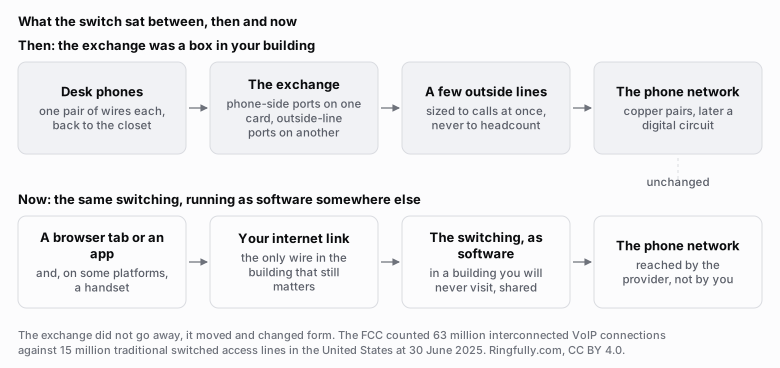
The exchange did not go away. It moved out of the closet and turned into software.
Reuse this figure anywhere, including commercially, with credit to Ringfully and a link back to this page. CC BY 4.0.
The two sides of the box
Open one and you find two kinds of port, and understanding the difference explains almost everything else.
The station side faces your desks. Those ports supply dial tone and ringing voltage to a phone. In the trade they are FXS ports, and the important thing about them is that they behave like the phone company: the phone plugged in is the passive end.
The trunk side faces the outside world. Those ports accept dial tone rather than supplying it. They are FXO ports, and the exchange is the passive end there. On a larger system the trunk side was not analog pairs at all but a digital circuit carrying twenty-three simultaneous calls plus a channel for signalling.
Every operational fact about an old phone system falls out of that split. Dialling 9 for an outside line was you asking the switch to find you a free trunk. A busy signal on 9 meant they were all in use. Direct inward dialling, where each person had their own public number, worked because the carrier handed the last few digits across the trunk group and the switch matched them to an extension.
Why the line count was never the headcount
This is the part that people forget, and it is the reason a PBX was worth buying at all.
Outside lines were expensive and mostly idle. A twenty-person office does not have twenty conversations running; it has three or four at the busy moment and none at lunch. So you bought lines to cover the busiest moment and shared them, and the switch is what did the sharing.
That arithmetic did not go away when the box did. It is still the question behind "how many people do I need answering", and the answer still comes from your busiest hour rather than your headcount. How many people do you need to answer calls works it through with real numbers.
What people actually had
Two different products got called a PBX, and the distinction still matters when you open the closet.
A key system gave every phone a row of line buttons. You pressed line 3 and you were on line 3. There were no extensions in any real sense, and everybody could see the whole set of outside lines. Most small offices had one of these.
A PBX gave each phone an extension number and hid the outside lines behind a dialling code. You did not know or care which trunk your call went out on.
By the 2000s the two had largely merged into hybrid systems that did both, sold under names like Norstar, Partner, Mitel and Panasonic. If your closet has a beige chassis with a fan and a punch-down block beside it, that is what you are looking at.
What the word means now
The switching function was the last part to leave the building, and it left in two stages.
First it became software running on a server you still owned: an IP PBX, with SIP phones on the office network instead of proprietary wiring. Same box, different protocol, still yours to patch.
Then it became a service. The switching runs in somebody else's building, shared across thousands of customers, and reaches you over your internet connection. People call this a hosted PBX, a cloud PBX or just a cloud phone system, and the three phrases mean the same thing.
The market has already made this choice. The FCC counts voice connections twice a year, and in its Voice Telephone Services report it recorded roughly 63 million interconnected VoIP connections in the United States against roughly 15 million traditional switched access lines as of 30 June 2025.
So do you still need one?
As a physical object, usually not. As a function, you never stopped needing it: something still has to decide which call goes where, and that something is what you are buying either way.
There are real cases where a local system still wins, and they are specific rather than sentimental: a site with unreliable internet where internal calls have to keep working, a building full of equipment that only speaks to a local switch, or a chassis bought two years ago with a support contract already paid for. On-premise PBX against a cloud phone system sets both columns out honestly.
If the box is old and the answer is to replace it, the order of operations matters more than the choice of vendor. That is how to replace an aging PBX, and the step that sinks most cutovers is not the phones. The handsets themselves outlive the switch more often than people expect, and what to do with old desk phones sorts the ones worth keeping from the ones that are scrap.
Where the money actually went
One last thing worth knowing about the old model, because it changes how you read a quote.
The purchase price of a PBX was never the cost of a PBX. There was the chassis, the cards, the handsets, the cabling, the installation, the programming, the annual maintenance contract, the moves-and-changes charges every time somebody swapped desks, and the outside lines themselves on a separate bill. A cloud quote bundles most of that into one per-seat number, which makes it look either cheaper or more expensive than it is depending on which pieces of the old bill you remember to add up.
The true cost of a business phone system lists the pieces so you can compare like with like. Our own numbers are on the pricing page.
More on this topic in migration.
What Ringfully is, in these terms
There is no box. Ringfully is the switching function as a service: the flows, the hours, the routing and the numbers live in software, and a person answers in a browser tab or in the Windows desktop application with a headset. There is nothing to rack, nothing to cool, and nobody comes to your office.
That is a real trade rather than a free win. Your internet connection becomes the only wire that matters, and if it goes down so does the phone. What happens when your internet drops is that trade written out in full.
Questions people ask
- What does PBX stand for?
- Private branch exchange. The exchange is the switch that connects calls. Branch means it was a branch of the public telephone exchange, sitting inside your building. Private means you owned it rather than renting the service from the phone company.
- What did a PBX actually do?
- Two things. It connected any desk phone in the building to any other without the call leaving the building, and it shared a small number of outside lines between everybody. A twenty-person office needed perhaps six outside lines, because six is the most calls that were ever up at once. The switch decided who got one.
- Is a cloud phone system a PBX?
- It does the same job, so people call it a hosted PBX or a cloud PBX. The difference is where the switching runs and who is responsible when it stops. Nothing about the function changed. The chassis, the cards and the closet did.
- How many outside lines does a phone system need?
- As many as the most calls you ever have up at the same time, plus a margin. That is almost never the number of people, because most of your staff are not on the phone at any given moment. Sizing to headcount is how offices ended up paying for lines that were never lit.
- Do I still need a PBX?
- Not as a physical box, unless you have equipment that only speaks to a local system or a site where the internet is genuinely unreliable. The switching function is still there in a cloud phone system. It just runs somewhere else and arrives as a subscription rather than a purchase.
About the author
John
Owner and CEO
Owner and CEO with over 10 years of experience in the IT industry, including more than 5 years specializing in VoIP and cloud communications. Experienced in designing, deploying, and supporting reliable communication solutions for businesses.

Keep reading
A free tool for this, in your browser: the phone cost comparator.
If you are leaving an on-premise system or a Centrex line, tell us what you have and when the contract ends, and we will lay out the order things have to happen in.