Blog
How to replace an aging PBX
The order that protects your numbers, and the analog stragglers that sink cutovers: the fax line, the alarm panel, the elevator car phone and the door release.
John · Owner and CEO · 10 min read ·
Replace it in this order: audit what is physically connected, find the things that are not phones, build the new system alongside the old one, run both on real calls, and move the numbers last. The numbers are the only step you cannot undo. The step that actually sinks cutovers is the second one.
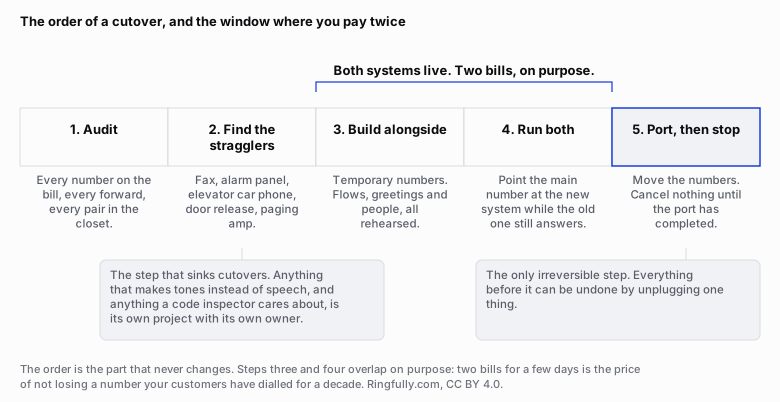
Steps three and four overlap on purpose. Step five is the only one you cannot undo.
Reuse this figure anywhere, including commercially, with credit to Ringfully and a link back to this page. CC BY 4.0.
Step one: audit what is actually connected
Not what the documentation says. What is connected.
Start with the bill, because it is the only honest inventory you have. Every number the carrier bills you for is a number that exists, and there will be more of them than anyone in the building believes: the main line, a fax number, a line the accounts department had in 2009, a toll-free number nobody cancelled, and a line whose only job is to be dialled by a machine.
Then open the closet and trace pairs. If you are not sure what you are looking at when you get there, what a PBX phone system is describes the station side, the trunk side and the hybrid systems most small offices actually have. You are looking for four things:
- Every number, and what it does. Write the purpose beside it. Any number whose purpose nobody can state is either a candidate for cancellation or a device you have not found yet.
- Every forward. Especially any that ends on somebody's personal cell phone. That is where the day-after surprises live, because the forward keeps working after the cutover and quietly delivers calls to a phone system you no longer have.
- The hunt order. Which number rolls to which, and in what sequence. This is almost never written down and is almost always wrong in the retelling.
- The pairs that do not go to a desk. Follow every one. That is step two, and it is the whole game.
While you are at it, find the demarcation point: the boundary between the carrier's wiring and yours. Under 47 CFR 68.105 a premises owner can ask where it is and the carrier has ten business days to answer, and if it does not answer the owner may presume it sits at the point where the wiring enters the building. Everything on your side of that line is yours to disconnect, and everything on the far side is not.
Step two: find the analog stragglers
Somewhere in your building is a device that has been quietly dialling out for eleven years and belongs to nobody. It is on a phone line, and it is not a phone.
The rule that covers all of them: anything that makes tones instead of speech, and anything a code inspector cares about, is a separate project with its own owner and its own lead time. None of them migrate like an extension. Several of them cannot be migrated by you at all.
The fax machine
Fax is a modem call. The two machines negotiate, then exchange page data as audio tones on a voice circuit.
A speech codec is designed to discard everything that is not speech, so it discards fax. Even with compression turned off and the audio carried untouched, a single lost packet at the wrong moment restarts a page, and a page that restarts three times fails. The standard written for this is ITU-T T.38, which stops carrying the audio and carries the fax data itself, re-timing at each end. It works, and it has to be supported by your adapter, your provider and the far end's carrier. You control one of those three.
The practical finding, over and over, is that the only faxes a small business still receives come from one insurer, one lab or one county office, and that an email-to-fax service costs less than making the machine work. Decide that deliberately, before the cutover, rather than discovering it on the Tuesday.
The alarm panel
Two separate problems, and the second is the serious one.
First, the panel signals its monitoring centre in tones down the line, which is the fax problem again with higher stakes.
Second, the panel supervises the line. It measures the voltage on the pair, and when the pair goes dead it raises a trouble condition, because a cut line is what an intruder does first. An adapter in your closet presents dial tone from a small box on your network. The moment your internet is out, the panel sees a perfectly healthy line, reports nothing, and can reach nobody. That is worse than no monitoring, because you believe you have monitoring. The requirements for how a supervising station is reached are set out in NFPA 72, and a fire alarm panel is the stricter version of the same conversation.
The answer comes from the alarm company, not from you, and it is usually a cellular or IP communicator. It is scheduled work with parts and a lead time. Call them in week one, not the week of the cutover, and do not let the copper be cancelled until they have signed off.
The elevator car phone
The phone in the elevator has to reach a person, and that requirement comes from the elevator safety code your jurisdiction has adopted rather than from your phone contract. Recent editions of the ASME elevator code go further and expect the communication means itself to be monitored, so that a failure raises a fault instead of waiting to be discovered by somebody trapped in the car.
You cannot solve this with an adapter and good intentions. Call the company that maintains the elevator, expect a cellular communicator, expect a lead time, and expect it to be inspected. Treat the line as untouchable until they tell you otherwise in writing.
The door entry system
Usually a door station wired to a station port on the old switch, plus a relay that throws the strike when somebody presses a key on their handset.
Two things break. The door station may be a proprietary device that only speaks to that switch, in which case it goes when the switch goes. And the release code is DTMF, which does not survive a compressed codec reliably unless the digits are carried as signalling events rather than as audio, the mechanism described in RFC 4733. A door release that works nine times out of ten is a door release that does not work.
The clean answers are a SIP door station that talks to the new system directly, or a local access-control circuit that never touches the phone system at all. Both are better than an adapter.
The rest of the list
Walk the building with this list and check each one:
- Payment terminal. A modem, same as fax.
- Postage meter. A modem, same as fax.
- Overhead paging amplifier. Usually fed from a port on the switch, so it needs an adapter presenting the correct side of the connection, and the volume and zones have to be re-tested.
- Gate opener or barrier intercom. Often dials out, often forgotten until a delivery driver is stuck at the gate.
- A modem on an old machine. A CNC controller, a scale, a time clock.
- The courtesy phone in the lobby and the phone in the loading dock. They are extensions, but nobody counts them because nobody sits at them.
And one question to ask the new provider in writing before you cut over: how a call to emergency services from each place your people work is handled, and what address it carries. Get the answer in an email, not on a call.
Step three: build alongside, on temporary numbers
Now, and only now, build the new system. Temporary numbers, real call flows, real greetings, real people trained on it. The old system keeps answering everything.
This is the moment to fix the menu, because it is the one time everybody agrees to look at it. The seven-option tree inherited from 2011 does not have to be rebuilt exactly as it was. Find the dead ends in your phone menu is a good half hour to spend here.
Step four: run both on real calls
Point the main number at the new system with a forward, while the old one still answers everything else. Then test the things that actually break, not the greeting:
- A transfer to somebody who does not pick up.
- A call arriving when everybody is already busy.
- A call at 7pm and a call on a holiday.
- A voicemail, all the way to whoever is supposed to read it.
- A call from a cell phone in the parking lot, not from a desk, because that is where audio problems show up.
- The greeting played on a real speakerphone rather than in headphones.
Give it a week if you can. A week catches the Monday morning peak and the Friday afternoon nobody thought about.
Step five: port the numbers, then stop
The port is the irreversible step. Everything before it can be undone by unplugging one thing.
What the losing carrier checks, and what a rejection looks like:
- The account name exactly as billed. Not your trading name, not the name on the door. A mismatch is a rejection, not a question.
- The service address as they hold it, including the suite number.
- The account number and any PIN. Get these from a recent bill or a customer service record.
- Whether the number is still active. A cancelled number goes back to the pool and is not reliably recoverable. This is why you cancel nothing first.
- Which number is the billing number. Porting part of a block and leaving the billing number behind is how an account ends up in a state nobody wants to unpick. Twilio's port-in documentation sets out the paperwork and the failure modes clearly, and other carriers ask for the same things.
Expect days, sometimes weeks. You will pay two providers for that overlap, and that is the price of not losing a number your customers have dialled for a decade. Related reading: a valid number is not an active line.
Port on a Tuesday morning. Not a Friday afternoon, and not the day before a holiday.
The week after
Keep the old system powered for two weeks. It costs nothing and it turns a rollback into a five-minute job.
Then check three things. That the bill actually went to zero, because a cancelled service that keeps billing is common. That every forward you found in step one has been removed, including the one to somebody's cell phone. And that whatever you decided about the fax has been told to whoever was still sending them.
More on this topic in migration. If you are doing this in Quebec, migrating from a PBX or Centrex line covers the local questions, including a shutdown deadline that gets quoted at Canadian businesses and is not theirs.
What we do here
We are not a self-serve migration. We build the flow with you in advance, prepare the port with you, and cut nothing over until the numbers have arrived. Numbers are provisioned by hand, which means a person reads your inventory rather than a form validating it.
The analog stragglers are the one part we cannot do for you. We have no engineer to send, and the alarm company, the elevator company and the access-control installer each own their own piece. What we can do is tell you in week one which of your lines are going to be a problem, which is the difference between a scheduled swap and a Tuesday nobody enjoyed. Start that conversation.
Questions people ask
- In what order should I replace an old phone system?
- Audit what is physically connected, find the things on those lines that are not phones, build the new system alongside the old one on temporary numbers, run both on real calls, and port the numbers last. The port is the only irreversible step, which is exactly why it goes at the end.
- What is an analog straggler?
- A device sitting on a phone line that is not a phone: a fax machine, an alarm panel, an elevator car phone, a door entry station, a payment terminal, a postage meter, a gate opener. Each one is its own project with its own owner and its own lead time, and each one is a reason a cutover fails on the day.
- Why does fax stop working on a VoIP line?
- Because a fax is a modem call, not a conversation. Speech codecs are designed to throw away everything that is not speech, and fax tones are not speech. Even with the audio left uncompressed, one badly timed lost packet restarts a page. The T.38 standard exists for this, and it has to be supported end to end rather than just at your end.
- Can I put my alarm panel on an adapter?
- Ask the alarm company, and ask before the copper is cancelled. A panel signals its monitoring centre in tones, which have the same problem as fax, and it watches the line's voltage so it can raise a fault when the line is cut. An adapter in your closet keeps presenting dial tone while the internet is out, so the panel reports nothing wrong and reaches nobody.
- How long before the cutover should I start the port?
- Start collecting the paperwork weeks ahead. The losing carrier matches the account name exactly as billed, the service address, the account number and any PIN, and a mismatch on any of them is a rejection rather than a question. Nothing is cancelled until the port has completed and the bill shows zero.
- Should I keep the old system running after the cutover?
- Keep it powered for a couple of weeks. It costs nothing, and it is the difference between a five-minute rollback and a bad afternoon. Cancel the old service only after the numbers have arrived and you have watched a full week of real calls on the new one.
About the author
John
Owner and CEO
Owner and CEO with over 10 years of experience in the IT industry, including more than 5 years specializing in VoIP and cloud communications. Experienced in designing, deploying, and supporting reliable communication solutions for businesses.

Keep reading
A free tool for this, in your browser: the phone cost comparator.
If you are leaving an on-premise system or a Centrex line, tell us what you have and when the contract ends, and we will lay out the order things have to happen in.