Blog
How call forwarding actually works
Forwarding does not move a call. It ends one call and places a second, and the line that forwards pays for it. What the caller sees, and where it belongs.
John · Owner and CEO · 6 min read ·
Call forwarding does not move a call. It ends one call and starts another. When a forwarded number rings, the network answers or redirects that first call, then places a second call to the destination and joins the two. Two calls exist, and the line that forwarded pays for the second one.
Two calls, not one
Nothing bends. The original call still terminates on your number, in the sense that your carrier's switch is the thing that decides what happens to it. What it decides is to originate a new call to the number you nominated, and to connect the audio of the two.
In the internet-telephony version you can watch this happen. RFC 5359, the IETF's collection of SIP service examples, writes out the message flow under the headings "Call Forwarding Unconditional", "Call Forwarding - Busy" and "Call Forwarding - No Answer". The redirect is an explicit response telling the calling side to try a different address. On a carrier line none of that is visible, but the accounting is identical.
Three things follow, and they are the whole article:
- Two calls can be billed. One to the caller, one to you.
- The second call can fail on its own. A destination that is busy, unreachable or blocked fails after the caller thinks they got through.
- The second call is dialled by your line. Not by the caller. That decides what the destination sees and who is charged.
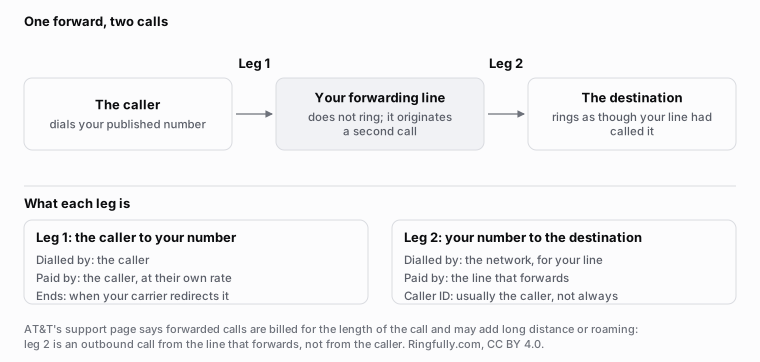
Two calls, not one bent call. Everything forwarding gets billed for, and everything it gets blamed for, follows from that.
Reuse this figure anywhere, including commercially, with credit to Ringfully and a link back to this page. CC BY 4.0.
Who pays for the second leg
You do. AT&T's call forwarding support article puts it plainly: forwarded calls are billed for the length of the call, and long-distance charges apply when you forward to a number outside your home calling area. Verizon's own FAQ says the same thing in different words, that you are billed for forwarded calls exactly as if you had answered them on the phone yourself.
That is not a gotcha. It is the direct consequence of the second leg being an outbound call from your line. But it changes the arithmetic on two decisions small businesses make casually:
- Forwarding the main line to a personal cell all day. The business line is billed for every forwarded minute, and the cell may be billed for its own airtime on the same call.
- Forwarding across a distance. A local number forwarded to a number in another region turns every local call into a long-distance one, on your bill, for the whole length of the conversation.
If you are working out what a phone line costs you in total, this is one of the lines that hides: the true cost of a business phone system.
What number does the destination see?
Usually the original caller's. Not always.
Two behaviours exist in the wild. Most North American carriers pass the calling party's number through to the forwarded-to phone, which is what makes forwarding useful at all: the person answering can call back. Some pass the forwarding line's number instead, which turns every forwarded call into a call apparently from your own office. A few do one thing on the display and another in the voicemail record.
There is no way to reason your way to the answer. Forward your line to a colleague, call it from a third phone, and look at what appears. That five-minute test is worth more than any vendor page, including this one. While you are testing, note that a number that rings is not proof of much on its own: a valid number is not an active line.
Three places forwarding can be set
The word covers three different mechanisms, and confusing them is the source of most "I turned it off and it is still forwarding" calls.
On the carrier's line. Set with a star code or in the carrier's account portal, stored in the network, applies to that one line. It keeps working with the phone off, because the phone is not involved. The codes are covered in call forwarding star codes explained.
On a handset. The Call Forwarding switch in a phone's settings usually is not a handset feature at all: it sends a request to the carrier and the carrier does the work. That distinction, and where it bites, is in call forwarding on an iPhone.
In a phone system behind your published number. Strictly this is not forwarding. Nothing is redirected, because the call was never pointed at a handset in the first place. The system decides where the call goes before any phone rings.
Which condition triggers the redirect is a fourth choice on top of these, and the one that strands callers most often: the four types of call forwarding.
When forwarding is the wrong tool
Forwarding is one line to one other line, unconditionally or on a single condition. It cannot ring two people at once, cannot ring one and then another, cannot check whether you are open, cannot offer the caller a choice, and cannot tell the person answering that the call came from the business rather than from a friend.
So the symptoms are predictable. Everything lands on one person, who answers "hello" instead of the company name. Nobody else can pick up when that person is driving. A caller with a billing question and a caller with an emergency arrive identically. And at 7pm the phone still rings, because forwarding has no idea what time it is.
Those are the points where a business outgrows forwarding rather than configures it better. Two of them are written up in full: one number, sales, service and billing and missed calls while everyone is busy.
How it works underneath
Ringfully does not forward your number to a phone, and the difference is worth stating because it is the difference between the two mechanisms above.
A call arriving on your number runs a flow you drew. A Business hours block decides whether you are open before anybody is disturbed. A Collect digits / Menu block offers the caller the choice, if you want one. Transfer to queue offers the call to the people who should take it, in the order you set, and Voicemail catches what nobody answers. The call is bridged into a conference of its own when it is answered, which is why hold, transfer and adding a third person are operations on one room rather than three separate features. That mechanism is described in why the transfer is the hard part.
There is one leg, not two, and there is no second number being dialled on your behalf. What replaces forwarding is not a better forward.
More on the mechanics of moving a live call, and the rest of this topic, in call control. If your line is forwarded somewhere today and you are not sure what it is costing you, tell us where it points and we will read it back to you.
Carrier behaviour varies by carrier, plan and region, and the two support pages linked above describe those two carriers rather than the industry. Check your own bill and your own line before relying on either.
Questions people ask
- Does call forwarding cost money?
- Usually, yes. Forwarding creates a second call out of your line, and carriers bill it as an outbound call. AT&T's support page says forwarded calls are billed for the length of the call and may add long distance or roaming. The caller pays for their leg; you pay for yours.
- Does the person I forward to see the original caller's number?
- Most of the time, and not always. Some carriers pass the original caller's number through, some substitute the forwarding line's, and a few pass one on the display and another to voicemail. Test it once from a third phone rather than assuming.
- Does call forwarding work when my phone is off?
- Unconditional forwarding does, because the redirect happens in the carrier's network before anything is sent to your handset. Forwarding that waits for you to be busy or not answer needs the network to try your line first, which is a different setting.
- Can I forward one number to two phones at once?
- Not with call forwarding. It is one line to one other line. Ringing two people at the same time, or one after the other, is a phone system's job rather than a forwarding setting, because something has to decide who is offered the call and in what order.
- Will the person answering know the call was forwarded?
- Not reliably. A forwarded call usually looks like an ordinary incoming call, which is why a forwarded business line answered on a personal phone tends to be answered with the wrong greeting. That is a real cost of forwarding and not a fault you can configure away.
About the author
John
Owner and CEO
Owner and CEO with over 10 years of experience in the IT industry, including more than 5 years specializing in VoIP and cloud communications. Experienced in designing, deploying, and supporting reliable communication solutions for businesses.

Keep reading
If callers get lost in the transfer, tell us how a call moves between your people today, and we will show you the same buttons in our app.