Blog
How many SIP trunks do you need?
Channels are sized against overlapping calls, not headcount. The arithmetic, a worked example, and what one channel too few actually costs you.
John · Owner and CEO · 6 min read ·
Count concurrent calls, not people. A channel carries one conversation at a time, so the number you need comes from how many calls overlap at your busiest moment, plus a margin. For a ten-person business taking forty calls in its busiest hour, that is eight channels, not ten and not forty. Here is the arithmetic.
The mistake worth avoiding first: headcount and daily call volume are both the wrong input, and they fail in opposite directions. Sizing on headcount usually overbuys. Sizing on daily volume usually overbuys wildly. This is one of the sizing questions collected in SIP and networks.
Step one: find your busiest period, not your average day
Averages hide the only thing that matters. A business taking a hundred calls spread evenly over eight hours and a business taking a hundred calls of which forty land between nine and ten need different numbers of channels, and the daily total is identical.
So the measurement is a peak, and for most small businesses an hour is the right window. If your day has a genuine rush, a specific ten minutes when the school run ends or the clinic opens, use a shorter window, because a steady hour containing a five-minute stampede will under-report the stampede.
Two figures come out of it:
- Calls in the busiest hour. Inbound and outbound together. Anything that crosses to the public network counts, including calls forwarded out to a cell phone.
- Average call length, from answer to hang-up, including any time spent on hold. Most small-business calls run three to five minutes. If you do not know yours, look at a phone bill rather than guessing, because guesses cluster at three minutes and reality often does not.
Step two: turn those into offered load
Multiply the two, divide by sixty. The result is measured in erlangs, and one erlang means one conversation continuously in progress for the whole period.
40 calls x 4 minutes = 160 minutes of talking 160 minutes / 60 minutes of clock = 2.7 erlangs
Two point seven erlangs is the floor. It says that during that hour, on average, 2.7 conversations are happening at once. Three channels would be exactly enough if calls arrived on a perfectly even schedule, which they never do.
The idea and the unit are old, and standardised: measuring traffic intensity this way is the subject of ITU-T Recommendation E.500, "Traffic intensity measurement principles". Nothing about voice over the internet changed the arithmetic, only what the channels are made of.
Step three: add the margin, and know what it buys
Calls do not arrive evenly. They cluster, and the margin above your offered load exists to absorb the clusters. How large it should be is not a matter of taste; there is a model for it.
The relevant one is Erlang B, which assumes a caller who finds every channel busy goes away rather than waiting. That is exactly what a trunk does to them, and it is why Erlang B and not Erlang C is the right model here: Erlang C describes a queue, and there is no queue outside a trunk. There is nowhere to stand.
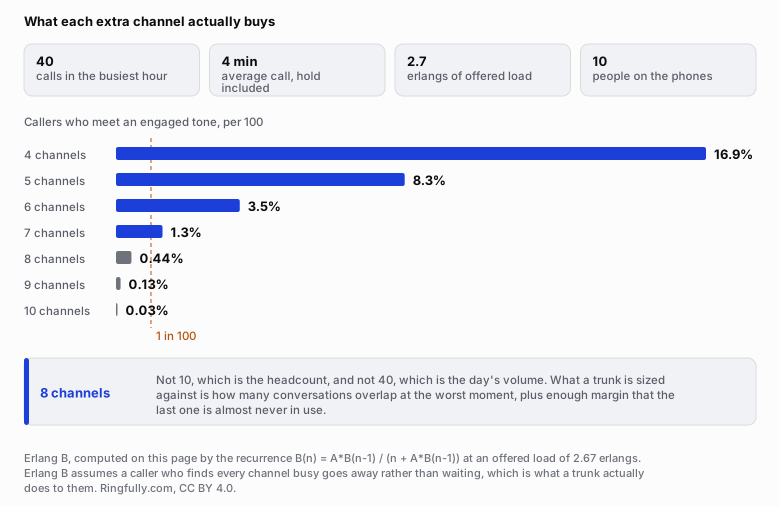
The same load at seven channel counts. The gain from four to eight is enormous; the gain from eight to ten is almost nothing.
Reuse this figure anywhere, including commercially, with credit to Ringfully and a link back to this page. CC BY 4.0.
Read the figure as the answer to "should I just buy plenty". Going from four channels to eight takes the chance of an engaged tone from about one caller in six to about one in two hundred. Going from eight to ten takes it from one in two hundred to one in three thousand, for the same money per channel per month. The curve falls off a cliff and then flattens, and the flat part is where overbuying lives.
For most small businesses, targeting one blocked caller in a hundred is the right place to stop. Somewhere tighter is defensible if a missed call is expensive; what missed calls are actually worth is how to put a number on that rather than a feeling.
What is not in the count
Four things people include that should not be:
Internal calls. Desk to desk, or extension to extension, stays inside your phone system and never crosses to the public network. It costs you nothing.
People. A ten-person team is not ten simultaneous conversations unless all ten answer at once, which for most small businesses happens approximately never. Our worked example has ten people and needs eight channels, and that is a coincidence of the numbers rather than a rule.
Phones. Twenty registered handsets on eight channels is a normal, correct configuration.
And one thing people leave out that should be in: calls forwarded out. A call that arrives on your number and is sent on to somebody's cell phone occupies two channels for its whole length, one in and one out. If you forward a lot, that alone can double your requirement.
Where hosted systems differ
If your phone system is hosted rather than sitting in your building, none of this appears on your invoice, because the trunks are the provider's and they have already been sized. What is SIP trunking explains which situation you are in.
The arithmetic still matters, but the question it answers changes. On a hosted system, capacity stops being about channels and starts being about people: not how many conversations can exist at once, but how many of them somebody can actually answer. That is the same offered-load figure fed into a different model, and our free Erlang C calculator does it, along with what one more person on the rota would change. How many people do you need to answer calls is the long version.
There is one thing to check on a hosted plan regardless of what the marketing says: whether there is a cap on simultaneous calls, and what happens at it. A published number is a number you can plan against. An unstated one is a number you discover on your busiest morning.
What too few actually costs, and why nobody notices
A caller who reaches a queue and waits produces a record. You can count them, look at how long they waited, and decide whether to do something about it.
A caller who reaches a full trunk produces nothing. The call never arrives at your system, so there is no record, no missed-call notification and no voicemail. From the caller's side there is an engaged tone or a message from a network they have never heard of, and no way to tell the difference between "they are busy" and "they are gone".
This is the strongest argument for a margin rather than an exact fit. The failure mode is invisible on your side and unambiguous on theirs, which is the worst combination a business phone system can have.
Ringfully runs the switch and the trunks behind it, so channel sizing is not on your invoice or your desk. Billing is per seat with the minutes included, and what a plan costs is the whole of it. If you are moving off a trunk you sized yourself, bring the two numbers from step one with you: they are still the right inputs, and they are the fastest way to say what your busiest hour actually looks like.
Questions people ask
- How many SIP channels does a small business need?
- Fewer than it has people. A ten-person shop taking forty calls in its busiest hour, four minutes each, has an offered load of 2.7 erlangs and needs eight channels for fewer than one caller in a hundred to meet an engaged tone. Six channels would turn away three or four callers in a hundred, and twelve would be money spent on channels that are almost never in use.
- Is one SIP trunk one call?
- It depends on who is selling it, which is the reason to ask. Some providers sell a trunk as a single concurrent call and you buy several. Others sell one trunk with a channel count attached to it. The unit that matters is the channel, meaning one conversation in progress, so get every quote restated in channels before comparing them.
- What is an erlang?
- One erlang is one conversation continuously in progress for the period you are measuring. Forty calls of four minutes in an hour is 160 minutes of talking inside sixty minutes of clock, which is 2.7 erlangs. It is the floor nobody can go below, and channels are that number plus a margin for the moments calls cluster.
- Do I count internal calls?
- No, if your phone system handles them internally, which almost all do. A call from one desk to another never leaves the building and never touches a channel. Count only what crosses to the public network: calls in from customers, calls out to customers, and anything forwarded to a cell phone, which does cross and does consume one.
- What happens if I buy too few?
- A caller who arrives when every channel is busy is turned away rather than queued. Depending on the provider they hear an engaged tone or a recorded message, and either way they cannot tell whether you are shut, out of business, or simply popular. Unlike a wait in a queue, this failure leaves no trace in your call records, which is why it goes unnoticed for years.
About the author
John
Owner and CEO
Owner and CEO with over 10 years of experience in the IT industry, including more than 5 years specializing in VoIP and cloud communications. Experienced in designing, deploying, and supporting reliable communication solutions for businesses.

Keep reading
If calls drop, go one-way or break up on your network, tell us what connection and router you have, and we will say where we would look first.