Blog
What a VoIP quote should itemize
The eleven lines a phone quote needs before two quotes can be compared at all, why an empty line is not a zero, and a blank form to send to a vendor.
John · Owner and CEO · 6 min read ·
A quote you can compare has eleven lines on it: the seat rate and the seat count it assumes, numbers, the allowance and the rate past it, add-ons, hardware, setup, number transfer, the term, the renewal rate, early termination and tax. A quote missing any of them is not cheaper. It is unfinished.
Most phone quotes answer two of the eleven properly and gesture at the rest. That is not usually dishonesty, it is a sales document doing what sales documents do, and the fix is on your side of the table: send the same eleven rows to everybody and compare what comes back.
The eleven lines
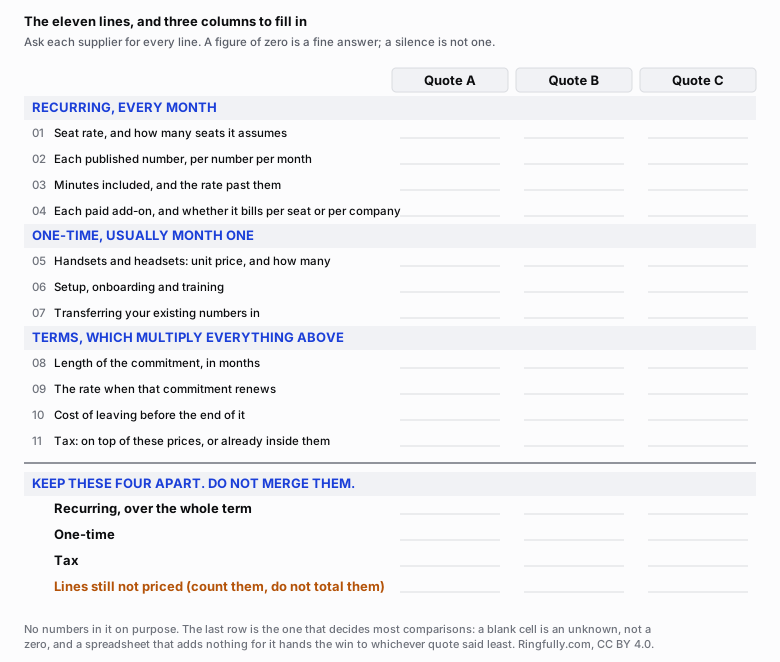
Deliberately empty. The last row is the one that decides most comparisons: a blank cell is an unknown, not a zero.
Reuse this figure anywhere, including commercially, with credit to Ringfully and a link back to this page. CC BY 4.0.
Recurring, every month. These are multiplied by the term, which is why an argument about two dollars here is worth having and an argument about two dollars in the one-time group is not.
- The seat rate, and how many seats it assumes. A rate with no count attached cannot be checked against anything. Ask in the same breath whether one licence may be used by more than one person, because the answers genuinely differ between suppliers and the difference across twelve people over three years is real money.
- Each published number, per number per month. Count them honestly: the main line, every direct line, the fax line still connected in the back, the number printed on the van.
- Included minutes, and the published rate past them. The rate matters more than the allowance, because the allowance is a promise about your usage and the rate is a fact about their pricing.
- Each paid add-on, and the unit it bills in. Recording, storage past the retention window, integrations, analytics, extra calls at once. Per seat, per number and per company are three different prices wearing the same label.
One-time, usually in the first month. These are not multiplied by anything, and they should never be averaged into a monthly figure.
- Handsets and headsets: unit price, and how many. This is often the single largest line in a first-year quote, and it is the line most worth challenging, because a browser tab is a phone and not everybody needs a handset.
- Setup, onboarding, professional services and training.
- Transferring your existing numbers in.
Terms, which are the multiplier on everything above.
- The length of the commitment, in months.
- The rate when that commitment renews. Ask for this in writing before signing the first term, not before signing the second.
- The cost of leaving before the end.
- Tax: on top of these prices, or already inside them. In the United States, ask separately about the federal universal service line item, which is a percentage of part of the bill rather than a fixed fee.
Why an empty cell is not a zero
This is the mechanism by which the wrong quote wins, and it is arithmetic rather than psychology.
Quote A itemises number transfer at four hundred dollars. Quote B does not mention number transfer. In a spreadsheet, Quote B is four hundred dollars cheaper, because an empty cell adds nothing. Nobody decided that. The spreadsheet decided it.
An unpriced line is an unknown, and it should stay visibly unknown until somebody produces a figure. That is why the form has a fourth total at the bottom that is a count rather than a sum: how many rows on this quote are still blank. A quote with two blanks and a higher total is frequently the better quote, and you can only see that if the blanks are counted.
A written zero is a completely acceptable answer. It just has to be written.
What the rules ask of a phone bill, and what they do not ask of a quote
There is a federal standard for how a phone bill has to be presented, and it is a good description of what a quote should look like too.
47 CFR 64.2401, the truth-in-billing requirements, says that charges on a telephone bill must be accompanied by "a brief, clear, non-misleading, plain language description of the service or services rendered", and that the description must be specific enough that customers can tell the services they are billed for are the ones they asked for and received, and that the cost matches their understanding of the price charged.
That is the standard, and it applies to the bill. It does not apply to the quote that produced it. Nothing requires a sales document to describe a charge in plain language, or to describe it at all, and that asymmetry is the entire reason this article exists. The clarity arrives with the invoice, which is eleven months too late to change suppliers over.
The three questions that move the total most
If you only ask three things, ask these.
"What is the smallest monthly invoice you can send me?" This catches seat minimums, which turn an advertised per-seat figure into a multiple. It is a different question from "what is your price", and it gets a different answer. The spread across published seat prices, and what a minimum does to it, is in how much VoIP costs per user.
"What is the rate at renewal, and what does it cost to leave before then?" Two numbers, one question, and both are usually available if asked before signature and negotiable only then.
"Which of these lines is an estimate?" Suppliers will tell you. The ones that will not have answered the question anyway.
How to send this to a supplier
Do not send a specification. Send the eleven rows, in an email, with your seat count and the number of published numbers stated up front so nobody has to guess, and one sentence asking for a figure on every line including zeroes.
Then send exactly the same email to everybody. The most common reason two quotes cannot be compared is that they were answering two different questions, and that is usually the buyer's doing rather than the seller's.
When the answers come back, fill the columns, keep the four totals apart, and negotiate the total rather than the seat rate. The reasoning behind that, with a worked example where the dearer seat price wins, is in the true cost of a business phone system. The charges that land later in the term rather than at the start are in hidden costs in a VoIP contract.
What we do not do
We do not send a quote with an unpriced line on it, and we do not publish anybody else's prices as though they were current. We have no office anywhere and no salesperson to send. Numbers are provisioned by hand rather than bought from a page, and there is no self-serve signup, which means the eleven lines get answered by a person rather than by a configurator.
More on buying and running phones as a service is on the cloud telephony topic page. If you want those eleven lines answered for your business, send us the numbers.
Questions people ask
- What should a VoIP quote include?
- Eleven lines, in three groups. Recurring: the seat rate and the seat count it assumes, each published number, the included minutes and the rate past them, and each paid add-on with the unit it bills in. One-time: handsets and headsets with a unit price and a quantity, setup and onboarding, and transferring your existing numbers in. Terms: the length of the commitment, the rate at renewal, the cost of leaving early, and whether tax sits on top of the prices or is already inside them.
- How do I compare two VoIP quotes fairly?
- Put them on identical rows and keep four totals apart: recurring over the whole term, one-time, tax, and a count of the lines still unpriced. Merging those into one number is how a comparison goes wrong, because it lets a large one-time charge disappear into a monthly average and lets an unanswered question count as zero.
- Why do phone quotes leave lines out?
- Sometimes because the charge genuinely does not apply, and sometimes because a quote with fewer lines wins a spreadsheet comparison. Both look identical on paper, which is why the fix is to ask for a figure on every line rather than to guess which silences are innocent. A written zero is a fine answer and a blank is not the same thing.
- Should I ask for a quote per seat or a total?
- Both, and insist that the total names the seat count it assumes. A per-seat rate with no stated count is not a quote, and a total with no stated count cannot be checked when your headcount changes. The seat count is also where the two most expensive misunderstandings live: whether a licence can be shared, and whether the vendor will sell you as few as you need.
- Is tax usually included in a VoIP quote?
- Not reliably, and the two treatments are not the same quote. A price quoted before tax and a price quoted after it can differ by more than the gap you spent the meeting negotiating. Ask which one you are looking at, and ask separately about any regulatory line item, which in the United States is a percentage rather than a fixed fee.
About the author
John
Owner and CEO
Owner and CEO with over 10 years of experience in the IT industry, including more than 5 years specializing in VoIP and cloud communications. Experienced in designing, deploying, and supporting reliable communication solutions for businesses.

Keep reading
A free tool for this, in your browser: the phone cost comparator.
If you are weighing a cloud phone system for a small team, tell us what your current one does that annoys you most, and we will say plainly whether ours changes it.