Blog
How much does VoIP cost per user?
The honest per-seat picture: what published seat prices actually run to, what the seat number leaves out, and how to turn a rate into a monthly figure.
John · Owner and CEO · 6 min read ·
Between $15 and $119 a seat a month across eight vendors whose pages were read on 19 August 2026, and none of those figures is the monthly cost. Ours are $29, $49 or $79 a seat. What the seat number leaves out is numbers, calling past the allowance, hardware, tax, seat minimums and a federal line item.
This article is about the gap between those two things. It is not the total-cost argument, which is worked through in the true cost of a business phone system; it is the narrower question of what a per-user price is and is not telling you.
What the spread actually means
The eight vendors in this site's own competitive analysis publish lowest tiers from $15 to $119 a seat a month. Two of those figures carry a caveat that travels with them: 8x8's came from a search snippet after the site returned an error, and RingCentral's is rendered by script rather than written into the page, so neither was read off a page the way the other six were. Both are drawn hollow in the figure below for exactly that reason, and none of these numbers should be treated as today's price without checking. They were read on 19 August 2026.
An eightfold spread is not a quality ranking. The cheap end is a phone system sold to everybody in a company. The dear end is contact-centre software sold to one department that answers calls all day, with workforce scheduling and quality management attached. Comparing the two on price per seat is comparing a van to a forklift on price per wheel.
Seat minimums, and the smallest cheque you can write
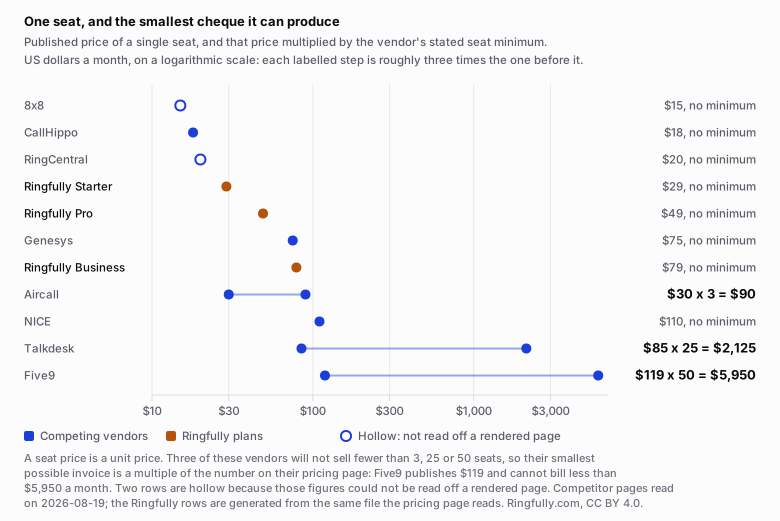
A seat price is a unit price. Three of these vendors will not sell fewer than three, twenty-five or fifty of them.
Reuse this figure anywhere, including commercially, with credit to Ringfully and a link back to this page. CC BY 4.0.
Three of the eight publish a seat minimum: three seats, twenty-five seats and fifty seats. That is the single most important thing on the chart and it never appears in a "from $X a month" headline.
Work it through. A vendor publishing $119 a seat with a fifty-seat floor is not a $119 product for a business of eight people. It is a $5,950 a month product, and there is no version of it that costs less. A vendor at $85 with a twenty-five seat floor is a $2,125 a month product. For a business of five to twenty people, the seat minimum decides the shortlist before the seat price gets a vote.
Ask the question in that form: not "what is your price per seat", but "what is the smallest monthly invoice you can send me".
The federal line item on a United States bill
There is one charge on a US phone bill that has nothing to do with your supplier's pricing and appears on nearly all of them.
Providers of interstate telecommunications contribute to the federal universal service fund, and the rule that governs how they pass that on, 47 CFR 54.712, contributor recovery of universal service costs from end users, sets the ceiling: if a contributor recovers its contribution through a line item on a customer's bill, that line item may not exceed the interstate telecommunications portion of that customer's bill times the relevant contribution factor.
Three things follow that are worth knowing before you compare two quotes.
- It is a percentage, not a fixed fee. It moves with your bill.
- The contribution factor is set quarterly by the FCC, so the same service can carry a different figure three months later without anything about your account changing.
- It applies to the interstate portion, which means two suppliers with identical headline prices can produce different line items depending on how they classify your traffic.
None of that is a reason to pick one supplier over another. It is a reason to ask each of them whether their quoted price is before or after it, because a quote "plus taxes and fees" and a quote "including all taxes and fees" are not the same quote and are routinely compared as though they were.
What else the per-seat number leaves out
- Numbers. Usually per number per month. Count every one: the published line, each direct line, the fax line in the back room, the number on the van.
- Calling past the allowance. Almost every plan includes an allowance of minutes and charges a published rate beyond it. Ours is 3.0¢, 2.5¢ or 2.0¢ a minute depending on the plan. A rate you can look up is worth more than a large allowance you cannot verify.
- Add-ons, and the unit each is billed in. Recording, storage past the retention window, integrations, analytics. Per seat, per number or per company, and the difference across twelve people is substantial.
- Hardware. Desk phones and headsets are one-time and they are frequently the largest single line in a first-year quote.
- Setup, onboarding and number transfer, which are also one-time and are the lines most often left blank.
The full checklist, in a form you can hand to a supplier, is what a VoIP quote should itemize. The charges that land in month eighteen rather than month one, from the renewal rate to what leaving early costs, are set out in hidden costs in a VoIP contract.
Turning a rate into a monthly figure
Five steps, in this order:
- Count seats, not people. A seat is a licence. Two part-timers covering one desk on different days may be one licence or two depending on the supplier's rules, and the bookkeeper who never answers the phone is neither. On a team of twelve the honest count is often nine.
- Check that count against the seat minimum. If it is below, the minimum is your price.
- Multiply, then add the numbers, at the per-number rate, for every number you actually publish.
- Add an estimate for calling past the allowance, using the published rate and last quarter's real minutes if you have them. If you do not, ask your current supplier for a call detail summary before you sign anything new.
- Add tax and the federal line item, and write them on their own row rather than folding them into the rate.
Do the one-time costs on a separate line entirely. Averaging a set of handsets over thirty-six months produces a tidy monthly figure and hides the fact that the money leaves in month one.
What we charge
$29, $49 or $79 per seat per month, billed in US dollars, with an allowance of minutes on every plan and a published rate of 3.0¢, 2.5¢ or 2.0¢ a minute past it. There is no minimum number of seats, so one seat is a real thing you can buy. Every plan also carries a monthly spend ceiling, which is the part of a bill nobody quotes for and which is explained in the surprise phone bill.
The full table of allowances, rates and ceilings is on the pricing page, and the figure above is generated from the same file that page reads, so the two cannot disagree.
What we do not do
We do not publish a comparison that claims to be today's price at any other vendor, because those pages change without anything breaking and the dates on ours are the only honest part of the exercise. We have no office anywhere. Numbers are provisioned by hand rather than bought from a page, and there is no self-serve signup.
More on running phones as a service is on the cloud telephony topic page.
Questions people ask
- How much does VoIP phone service cost per user?
- Published seat prices at the eight vendors in our own competitive analysis ran from $15 to $119 a month when their pages were read on 19 August 2026, and two of the lowest figures could not be confirmed on a rendered page. That spread is not a quality ranking: the cheap end is a phone system sold to a whole company, and the dear end is contact-centre software sold to one department. A seat price is also a unit price rather than a monthly cost, because it says nothing about how many units the vendor will sell you.
- Why is my VoIP bill higher than the advertised price per user?
- Because the advertised price covers a licence and your bill covers everything else. Numbers are usually charged per number per month. Calling past the included allowance is charged per minute. Recording, extra storage and integrations are often billed separately, and it matters whether each is per seat or per company. On top of all of that sits tax and, in the United States, a federal universal service line item calculated as a percentage of the interstate portion of the bill.
- What is a seat minimum and why does it matter?
- It is the smallest number of licences a vendor will sell. Three of the eight vendors in our analysis published one, at three, twenty-five and fifty seats. That turns the advertised figure into a multiplier: a vendor publishing $119 with a fifty-seat floor cannot bill you less than $5,950 a month no matter how many people you actually have. For a business of five to twenty people, the seat minimum decides more than the seat price does.
- Is annual billing cheaper than monthly for VoIP?
- Usually, and it is not the same offer. The lower annual rate is paid for by giving up the right to stop, so an annual figure divided by twelve is a number that describes neither deal. Compare annual against annual and monthly against monthly, and ask separately what the rate becomes when the term renews, because the discount often does not.
- How do I work out what a phone system will actually cost me per month?
- Count the people who will be offered calls, not the people on the payroll. Multiply by the seat rate, check whether that count clears the vendor's seat minimum, add every published number, add an estimate for calling past the allowance at the published rate, add any add-on you would switch on, then add tax and the federal line item. Do the one-time costs separately and do not average them into the month.
About the author
John
Owner and CEO
Owner and CEO with over 10 years of experience in the IT industry, including more than 5 years specializing in VoIP and cloud communications. Experienced in designing, deploying, and supporting reliable communication solutions for businesses.

Keep reading
A free tool for this, in your browser: the phone cost comparator.
If you are weighing a cloud phone system for a small team, tell us what your current one does that annoys you most, and we will say plainly whether ours changes it.