Blog
Hidden costs in a VoIP contract
Overage, porting fees, hardware you may not own, the renewal rate, early termination: where the money in a phone contract hides, and what to ask before signing.
John · Owner and CEO · 6 min read ·
Almost nothing in a phone contract is actually hidden. It is misfiled: real charges spread across three years, described by a quote that covers one month. The five that catch people are calling past the allowance, transferring numbers in and out, hardware ownership, the renewal rate, and leaving early.
Each one below has the question to ask attached, because every one of them is answerable in writing before you sign and difficult to move afterwards. If the headline rate is still the open question rather than the extras, how much VoIP costs per user takes apart what a seat price does and does not cover.
When each charge actually lands
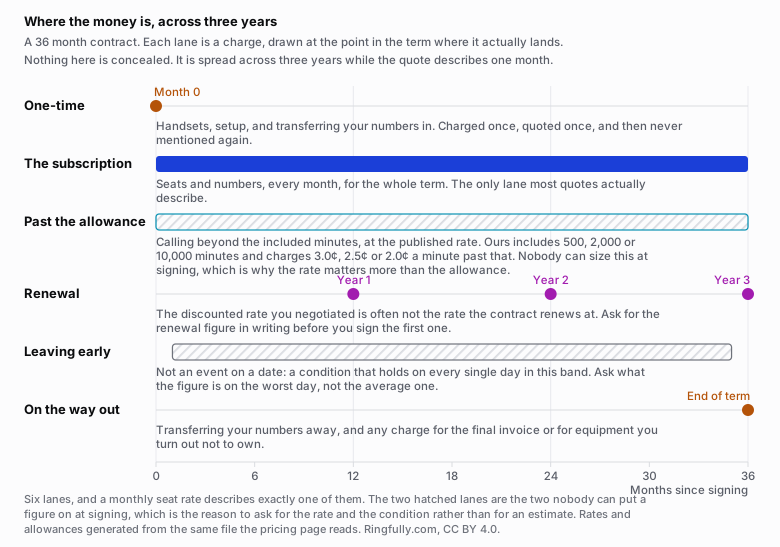
Six lanes, and a monthly seat rate describes exactly one of them.
Reuse this figure anywhere, including commercially, with credit to Ringfully and a link back to this page. CC BY 4.0.
Six lanes over thirty-six months. A monthly per-seat rate describes one of them. The two drawn as hatched bands are the two nobody can put a figure on at signing, which is precisely why they need a rate and a condition rather than an estimate.
Calling past the allowance
Nearly every plan bundles an allowance of minutes and charges a published rate beyond it. The allowance is a claim about your usage, which nobody can verify in advance. The rate is a fact about their pricing, which anybody can check.
So ask for the rate, in cents per minute, and ask for it separately for each thing that is priced separately: long distance, calls to cell phones, toll-free inbound, and anywhere international you actually call. Ours is 3.0¢, 2.5¢ or 2.0¢ a minute depending on the plan, and it is on the pricing page rather than in a schedule attached to a contract.
Then ask the question behind the question: what stops the meter. A rate you can look up does not help on the weekend somebody's stolen password runs premium-rate calls all night. What helps is a monthly ceiling the system enforces on its own, without needing anybody awake to read an alert. Ours is $200, $1,000 or $5,000 depending on the plan, and how that works when it is reached is in the surprise phone bill.
Ask: what is the per-minute rate past the allowance, for each category, and what is the mechanism that caps a bad month?
Transferring numbers, in and out
Bringing your numbers in is often quoted, sometimes at a per-number fee and sometimes bundled. Taking them out again at the end is quoted far less often, and it is the same work.
There is a rule here worth knowing, because it decides what a contract can and cannot do to you. 47 CFR 52.34, obligations regarding local number porting to and from interconnected VoIP providers, requires a provider to facilitate a valid porting request, which it defines as an affirmative legal obligation to take all steps necessary to allow the port "without unreasonable delay or unreasonable procedures that have the effect of delaying or denying porting". Paragraph (b) goes further: a provider may not enter into any agreement that would prohibit a customer from porting between providers or to and from a telecommunications carrier.
So your number is not something a contract can hold hostage. What a contract can still do is charge a fee for the administrative work, and what a supplier can still do is use every day of the permitted interval. Neither is a lock, and both cost you time you did not budget.
Ask: what is the fee to port each number in, what is the fee to port each number out, and how many business days does each take?
Hardware you may not own
A desk phone on a quote can be three different things: bought, rented over the term, or included in a bundle that becomes a charge if you leave early. All three look like a phone on a desk.
A rented handset is a recurring line that runs for the whole term and has to be returned in working order at the end of it. A bundled handset is often a discount that unwinds on early termination. A purchased handset is yours, and may still be locked to that supplier's provisioning, which makes it worth nothing to the next one.
Ask: for each handset, am I buying it or renting it, what is the make and model, and can it be unlocked for another supplier at the end?
The renewal rate, and the term restarting
This is the one that costs the most and is asked about the least.
A discount is negotiated for a first term. The contract renews. The rate reverts, or steps, and the term restarts, which quietly resets the early-termination clock at the same moment. A business that thought it was twelve months from being free is now thirty-six months from it, having signed nothing.
Two related things to pin down. The notice period for stopping a renewal, which is often a specific window before the anniversary rather than any time you like. And whether the renewal is month to month or a fresh full term, because those are very different positions to negotiate from.
Ask: what is the rate at renewal, does renewal start a new term, and what notice do I have to give and by when?
Leaving early
Early termination is not an event on a date. It is a condition that holds on every single day between the first and the last, which is why the figure above draws it as a band rather than a pin.
The number is usually the remaining months multiplied by something, and the something varies: the full monthly charge, a percentage of it, or the full charge plus the unwinding of any hardware discount. Ask for the formula rather than for an example, and then ask what it produces on the worst day of the term rather than the average one.
There is a second, quieter version of this. On some committed plans a seat you stop using keeps being billed to the end of the subscription period, while a seat you add is billed immediately. In a business whose headcount moves with the season, that asymmetry is a structural cost that never appears in the rate anybody negotiated. It is examined with its source in the true cost of a business phone system.
Ask: what is the early-termination formula, and what happens when I remove a seat mid-term?
Putting it on one page
Every question above belongs on the same sheet as the price, which is what the eleven-line comparison form in what a VoIP quote should itemize is for. Send it to each supplier, keep recurring, one-time, tax and unanswered lines apart, and negotiate the total.
The one thing worth repeating: a supplier who answers all of it in writing before you sign is telling you something useful about what the next three years will feel like.
What we do not do
We do not quote a rate that is not on the pricing page, and there is no minimum number of seats to clear before you can buy one. We have no office anywhere and no on-site technician. Numbers are provisioned by hand rather than bought from a page, and there is no self-serve signup: setup is done with you.
More on the money side of running phones as a service is on the cloud telephony topic page. Allowances, rates past them and the spend ceiling on each plan are on the pricing page.
Questions people ask
- What are the hidden costs of a VoIP phone system?
- Calling past the included allowance, charges for transferring numbers in and out, handsets that turn out to be rented rather than owned, the rate the contract renews at once the introductory term ends, and the cost of leaving before it does. None of them are concealed. They are simply spread across three years while the quote that sold them describes one month.
- Can a phone provider stop me taking my number when I leave?
- No. Federal rules require providers to facilitate a valid porting request without unreasonable delay or procedures that delay or deny it, and they specifically prohibit an agreement that would stop a customer porting between providers. What a contract can still do is charge you a fee, and what a supplier can still do is take the full permitted interval. Order the transfer before you cancel anything.
- What happens when a VoIP contract renews?
- Often the rate changes, and often the term restarts. A discount negotiated for a first term is frequently not the renewal rate, and a renewal that quietly starts a fresh commitment resets the early-termination clock at the same time. Ask for the renewal figure in writing before signing the first term, and ask what notice period applies to stopping it.
- Are VoIP handsets owned or rented?
- Both arrangements exist and the quote does not always say which. A rented handset is a monthly line that continues for the term and has to go back at the end, and a purchased one is yours but may be locked to that supplier's provisioning. Ask for the make and model, ask whether it can be unlocked, and get the answer before the contract rather than at the end of it.
- How do I avoid a surprise phone bill?
- Two things. Know the published rate past your allowance so a busy month is arithmetic rather than a shock, and set a monthly ceiling the system itself enforces, so a stolen login or a forwarded line cannot run indefinitely while nobody is watching. A warning email is not protection; it depends on somebody being awake to read it.
About the author
John
Owner and CEO
Owner and CEO with over 10 years of experience in the IT industry, including more than 5 years specializing in VoIP and cloud communications. Experienced in designing, deploying, and supporting reliable communication solutions for businesses.

Keep reading
A free tool for this, in your browser: the phone cost comparator.
If you are weighing a cloud phone system for a small team, tell us what your current one does that annoys you most, and we will say plainly whether ours changes it.